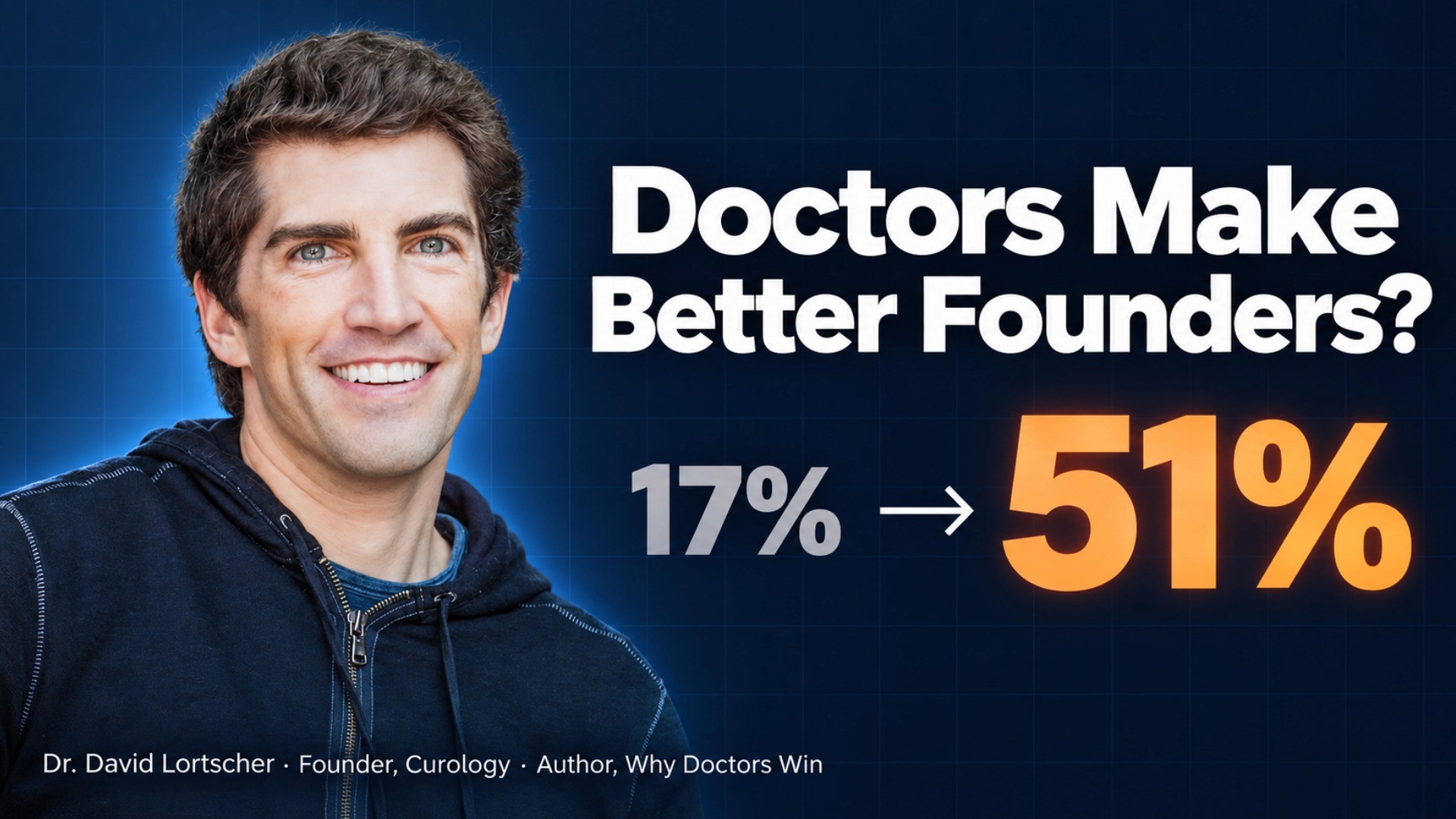
Investors often say they won't back physician founders. Dr. David Lortscher, dermatologist, founder of Curology, and author of Why Doctors Win: The Doctors' Guide to Creating or Joining a High-Impact Startup, found the data says otherwise. Physicians founded just 17 percent of healthcare startups, yet they founded 51 percent of the most valuable healthcare companies, including Intuitive Surgical and Gilead. In this episode, Trevor Royce and Tim Showalter sit down with David to talk about what doctors bring to the table and what they still have to learn.
David takes us back to 2012, when his patients in rural New Mexico were driving two hours each way for appointments that didn't need to be in person. Rather than digitize the office visit, he rebuilt the whole care model. That meant full-time dermatologists, hundreds of keyboard shortcuts to make consults fast without losing quality, and a $20 monthly subscription that covered both care and medication. It also meant months in his kitchen teaching himself to compound acne creams that people would actually want on their faces. That work eventually became a 50,000 square foot compounding pharmacy in Pittsburgh. David is also candid about his biggest early mistake as CEO, which was underinvesting in marketing, and why doctors need to stop acting like the expert in the room once they join a startup.
The conversation then turns to the book's core framework: a great company needs a transformational product and a clear path to winning the market. David shows how that played out at Abridge, which launched a patient-facing app before building its AI scribe, and at Viz.ai, which won by building stroke detection into the clinical workflow and cut time to treatment dramatically. He also walks through a supplement idea he loved but ultimately walked away from, and shares practical ways physicians can find their way into startups, from incubators and MBAs to blogging, building apps, or taking a year to work inside a great company.
Episode Resources:
Transcript
Dr. Trevor Royce: Good morning, Tim
Dr. Tim Showalter: Good morning.
Dr. Trevor Royce: It's starting to feel a little cooler. Starting to go outside a little more. And took my kids fishing this weekend to a a local pond
Dr. Tim Showalter: Oh, nice. What'd you fish for? Bass or?
Dr. Trevor Royce: So yeah, we got a little rock bass seeing my daughter catch her first fish like totally unassisted was an awesome thing. Just like the the tug is the drug, it's like definitely got a little adrenaline and seeing that fish flop around was you know it was pretty awesome.
Dr. Tim Showalter: When they come, when they surface and they just attack the bait or the the fly, whatever you use in it, it's it's pretty amazing.
Dr. Trevor Royce: Yeah. And then my five-year-
Dr. Tim Showalter: It's almost trout season here, so they'll be stocking the streams pretty soon. It's pretty exciting.
Dr. Trevor Royce: Shenandoah, make it happen. Should we do it? All right. And welcome back to Health Tech Remedy. This is the show where leaders in health technology break down the stories behind today's most innovative health companies, and we speak with those leaders shaping the future of care. I'm Trevor Royce, I'm a radiation oncologist and researcher, and I'm joined with by my co-host, Tim Showalter.
Dr. Tim Showalter: Morning, everyone today we're doing something a little bit different. We're going to talk with David Lortscher, the dermatologist and founder of Curology. But the center of gravity for this episode is actually his new book Why Doctors Win, The Doctors' Guide to Creating or Joining a High-Impact Startup, which I had the pleasure of enjoying during my spring break trip this year.
Dr. Trevor Royce: Yes. I mean, obviously, we're biased as physicians, but the kind of core concepts and themes here appeal to us as entrepreneurs and people in health technology with physician backgrounds and clinically active. Obviously, relevant to the show, talks about the book and Tim you've read it, so you can speak to this kind of more directly, but you know, what are the the key attributes or characteristics of physicians that may bring them specific advantages in this world of health technology, health care startups and these entrepreneurial pursuits and health care broadly, not just as advisors or medical validators or evaluators, but actually as like core founders, executives, product thinkers, operators, the actual you know meat and bones of these people, how do they contribute uniquely to this environment.
Dr. Tim Showalter: Yeah, I mean, this book is provides a lot of like how-to perspective on choosing business ideas that will that will work and deciding which teams to join I also think it's a it's a good challenge for physicians. I mean, implicit in this in the title of the book is that a clinical perspective is really important to the success of any company trying to make a an impact in health care. And of course, doctors may understand the problem deeply. But really, in order to make an impact, you've got to take an active role on some side of of health technology or or whatever your your chosen path is and really add to your clinical insights to become a part of the operating or strategic team. And I think that's what makes David's perspective interesting he really in the Curology story in particular, I think, which is a good good example for how physicians can can make a positive impact in this space, he really had to redesign the overall care model. So it wasn't just about, you know, hanging up a shingle in the virtual world but really going deeper to to change the dermatology experience.
Dr. Trevor Royce: Yes, totally. And I think you know, a key part of this is that clinical expertise alone, and this is something that we've chatted about, you not make someone intrinsically a good start-up founder. You know, doctors could understand the problem deeply, but they still have to learn the market, the buyer, the business model, the regulatory path, the implementation burdens and you know the speed that it takes to build a company. You know, just being a clinical expert, obviously, does not perfectly translate to being a founder, and there's so many stories of overconfident physicians becoming entrepreneurs that have not panned out. However, to your point, having the intrinsic qualities that made you a successful professional as a physician having the drive, the you wherewithal to self-teach and figure out a very complicated clinical landscape, obviously, those like key principles and attributes of success translate and can translate very well to an entrepreneurial world. And then I think really where that differentiator comes is obviously the truly deep understanding of the clinical experience, the doctors who are often the customers or the patients and their experience who are the other most common customer in health technology, deeply what those those entities are dealing with, truly obviously makes you have a better appreciation and guide as a product.
Dr. Tim Showalter: I love that. I think that's kind of core to what I took away from the book, which was that doctors and other clinicians should not necessarily view startups as something outside of the profession of medicine, but really as a way to extend impact. But in order to do it, it's like you've got to learn a new skill set, it's a new procedure set of procedures, it's you the field is is evolving so much. And doctors can create them or join them or advise them, sometimes lead them. But to do that well and to have it be an extension of their medical careers, they need to translate clinical judgment into real business insights and and operational competencies. And that means knowing when to to be precise and iterate on a problem and when to move fast. And think it's really exciting to to hear how he had a few ideas he thought about before Curology and ultimately how he landed on solving the set of problems that he took on.
Dr. Trevor Royce: Yeah, totally. I think the Curology story is a great application of these concepts, obviously told through David's story and will you know be a good illustration of this entrepreneurial journey from the physician perspective and how they can uniquely contribute and ultimately have a successful business. So it'll be a really fun interview.
Dr. Tim Showalter: Yeah, excited to hop in. So listeners, stay tuned for our conversation with Dr. David Lortscher.
Dr. Trevor Royce: Let's do it.
Dr. Tim Showalter: David, welcome to HealthTech Remedy. It's great to have you here
Dr. David Lortscher: Thanks so much guys. Great to be here.
Dr. Tim Showalter: So you are a Board-certified dermatologist, the founder of Curology and now the author of Why Doctors Win, the doctor's guide to creating or joining a high-impact start-up and Curology is one of the most interesting examples of a physician-founded company that started with a specific access problem and you did it like right after your training, which is pretty remarkable that that you sort of got on it right away. So I we really want to talk to you about both stories, both the Curology side as as well as this this great book that you've you've provided the field. So really looking forward to to hearing sort of bits of information
Dr. Trevor Royce: So David, let's start with your own origin story. You know, we'd love to hear a little bit about your background and kind of how you came to be doing what you do. As I understand it, you were practicing dermatology in New Mexico before starting Curology We'd love to hear a little bit about how you got there, what you were seeing in clinic that made you feel the dermatology system wasn't working and take it from there
Dr. David Lortscher: Yes. So so this was back in twenty twelve. And it was that year that smartphone penetration in the U.S. had just passed about fifty percent. And so it was clear to me and I think a lot of other people that the way patients receive care was going to change over the next few years by a lot, right? And so one of the ways that was going to change is telehealth. And you know in New Mexico, I had many of my patients driving two hours to see me. You know it's just one of those places where you do not have many physicians. And as I was looking for solutions to help these patients be seen without coming into the office, you for a lot of the things, there was no reason they needed to drive two hours each way I began to look into telehealth solutions. And and and so that was really the impetus for me to start thinking about a company in the space
Dr. Trevor Royce: In accessing dermatologists, the cost, complexity of prescriptions, the consumer experience, all of the above, you know, and and how was telehealth able to address some of that?
Dr. David Lortscher: Yes. I mean, so it was it's two things. So one is just the the remoteness of many people from medical specialists, which is obviously still a problem in the country and then it was the cost as well. But so as I was like to my patients trying to help them find a telehealth solution so they could see me more easily there were already about ten to twelve dermatology telehealth services on the market. But as I was looking through them, none of them actually seemed to solve the full problem in my eyes. And the way that most of them worked at the time was that, you're a patient, you go online to see a dermatologist through one of these start-up portals, and you pay sixty dollars and a dermatologist will see you asynchronously and then, back to you, prescribe medications and then follow up with you as needed. And for many patients, that worked well but for for most of my patients, what I saw is that sixty dollars to see a doctor was actually a pretty ridiculous $sixty a a actually doctor pretty ridiculous see to was cost. And they're you know they're used to having insurance cover everything and of course back then insurance wasn't covering telehealth at all and so you the way that that that the business model worked for a lot of these telehealth companies is that they would pay the dermatologist thirty out of the sixty dollars and then the telehealth company would take home the other thirty. And the the sort of counterintuitive insight that we had was that thirty dollars, although it may not seem like much to pay a doctor for a consult, for this case was actually one a actually case consult, for this was way too much. Like if you were able to design a process where you could see a patient in less than five minutes and yet make it a delightful experience, you'd be able to finally make this affordable for patients. And so you'd be solving both the problem of like how difficult it is to get to a dermatologist physically, but then also like making sure it's affordable for patients as well.
Dr. Trevor Royce: Yeah. And I guess just to round this out a little bit in terms of some of the unique features of dermatology, I mean it's a very visual specialty and someti- and the acuity is such that maybe it lends itself well to telehealth. Is that sort of part of this contributing as well?
Dr. David Lortscher: Yeah, big time because you yeah, as you're saying, you don't need to listen to a patient's heart if you're a dermatologist. You know, you don't need to perform any procedures on them in the for the most part. So yes, it's especially with acne and many other things you don't need to necessarily feel a patient's skin or do a biopsy, it lends itself very well to telehealth.
Dr. Tim Showalter: I'll just say as the father of teenage kids who like deal deal with this acne thing, I think that obviously one one of the things that I would look for for the virtual care model, it seems like you've solved it for this as well, is just meeting people where they are on the scheduling side and not having to wait like months to to get into a dermatology appointment. I think we've all had that experience where like the dermatologist will see you but they'll see you in four months too, like there's a real like time to access problem and having to miss school or take off work to do it is just where I see a huge opportunity as well.
Dr. David Lortscher: Yep, yep, absolutely.
Dr. Tim Showalter: Well, I wanna get into a little bit about the actual nitty gritty of the Curology sort of care stack a little bit. I know that there's a lot of elements that are complicated, right? There's like figuring out what are the personalized prescription formulas that are gonna be there, like actually what's delivered, the teledermatology side. I think you dealt with compounding and what's the what's the business model for subscription know and and how those get fulfilled and then of course there's the the standard business stuff like consumer branding things like that. Tell me about the learning process for that like where what were things like when you started and how did they evolve over time?
Dr. David Lortscher: Yes. So our business model stayed the same basically from day zero. So the business model that we pursued was a little odd and that a patient would pay us twenty dollars every month and that would cover their medical care and then it would also cover these compounded medications you're mentioning and so part of the part of the innovation back then was being able to see the consultations extraordinarily efficiently and then we believe that if we were able to lower the price by seeing the consultations so efficiently, we'd have enough volume that we could make our own medications in-house. And so that's what we did and by compounding our own medications and doing that very efficiently, we were able to get them the whole care package for twenty dollars a month. And so the original focus was on acne. And these these patients, many of whom were in their twenties or late teens found this just to be an an incredible value proposition because as you mentioned, you know it's it's it's not just the getting them the care on time, but it's also getting them the and then making sure that it's affordable as well so so yeah that was that was the whole package and when we launched that was the exact business model and it stayed the same ever since.
Dr. Tim Showalter: That's remarkable. But I think there's also a a story of all the extra work and creativity you had to apply to deliver that. So as I understand it, you basically did more than digitize the office visit. As you said before, there are other companies that had had invented this like real know had had delivered this real-time patient doctor visit built around a classic clinic's clinic schedule. But you really had to reinvent the workflow overall. So provider review, digital image review, personalized treatment and and shipment. How did you decide in working with your care team what parts of the traditional dermatology experience to keep and which parts to rebuild or did you just remake the whole thing basically?
Dr. David Lortscher: Yes. I mean, this is the part where being a physician, I think, gave us a big advantage in deciding this this new sort of care paradigm that we built for our company. And basically, the the part that I saw that we didn't want to keep was was having part-time dermatologists see patients for us. I believe that we would never get to a really high level of care and a high level of efficiency if we had part-time dermatologists. So from the very beginning, the plan was we need to have doctors who not just know how to treat acne and and be a dermatologist, but how to do that very efficiently on this specific platform. So you know, from the beginning, I built these three hundred different keyboard shortcuts where you type a dot and then three letters. And for every single like long tail use case where maybe some weird protein powder is causing someone's acne, I could just type like four keystrokes and the patient would get this this concise but like explanation of how to make their acne but clear concise explanation how like like make of of their this to acne get better. And so by by doing a little more work upfront and by forcing every new dermatologist who came on to come on full time and then do that additional work to be able to to learn how to do this efficiently we were able to really really decrease the cost per consult while keeping the quality really high.
Dr. Tim Showalter: Yeah, that's so like an individual doctor can do a lot more, which affects your like goal for the for the price, which is great. And obviously, a lot of these are operational advances, you're really getting into the weeds of the overall operations, be it know the the provider aspects, the I'm I'm sure the compounding pharmacy logistics of fulfilling things, customer service queries, regulatory considerations. Which of these operational areas that you had to solve for were a lot harder than expected?
Dr. David Lortscher: Yeah. I mean, the thing that I still have nightmares about is trying to figure out how to compound the creams on our own and I did not expect that to be difficult, right? Because as a dermatologist, I had ordered compounded creams for my patients with certain types of psoriasis or like certain types of cutaneous lymphoma. And it seemed easy. I just called the compounding pharmacy, they go pick it up and it may be expensive, but it wasn't that difficult to do and I was very surprised when I realized like, hold on, this is not going to work. We're going to have to sort of reinvent it. And the main reason is that when I was doing initial research, I would call in like a combination acne cream to a compounding pharmacy. This is nothing they've gotten a prescription for before, right? People didn't do these compounding creams. And so when I got it back, it was sort of weird, it was gritty, it would liquefy, and it was not something that anyone with any self-respect would put on their face. And so I sort of was sitting there in my apartment in the kitchen for months and months on and apartment for in in kitchen months months my the on end trying to figure out how to make these compounded formulations better. And so I had to learn way more than I thought I'd have to learn about how to make different emulsions, whether it's an oil and water emulsion or water and oil emulsion and how to get the the active ingredients micronized to be the right size to like like in the in the emulsion. And and then you know also figuring out how do we make sure that these are not inactivating each other. So working with like finding these analytical labs to to like you them over time to make sure the ingredients aren't degrading. And so you know that was a part of the business that I didn't really expect to go as deep on, but it it was probably like fifty-two percent of my time for like the first for the first twelve months at least.
Dr. Trevor Royce: That is really, really interesting. I'm curious, you know, now that time has gone by and I assume, company has changed and workflows have changed, much of that is still a challenge for you all? Or is that a lot of that pretty much solved?
Dr. David Lortscher: Yes. I mean, I think it's it's now it's a strength for us because we we know how to like when we want to innovate with a new formulation or like get moved to a new use case, you we we're we're we know how to do it much faster than anybody else and with with a result that like works much better for the patient. So you know we have dozens and dozens of different permutations and combinations of formulations that we make. And so we can start somebody on a really gentle formulation as an and then as our skin you gets used to it, we can you know start to give them something stronger. And so you know we we we really like honed that into a big talent for the organization. So our doctors know how to prescribe it, our nurse practitioners know how to use it very wisely. And then our our compounding pharmacy knows how to to make it efficiently, but then also to to build new creams as the doctors create demand for it.
Dr. Trevor Royce: Very cool. Very interesting. Is is that a big focus currently of Curology then today?
Dr. David Lortscher: It is, yeah. I mean, we have a fifty thousand square foot compounding pharmacy in Pittsburgh, and it's you know it's it's a big core of our operations.
Dr. Trevor Royce: Amazing. And I guess related to that, going back to something that you touched on earlier, you know, one thing that I hear a lot from angel investors or early-stage investors, period, is like, I I have the scar tissue to show for it and I no longer invest in physician founders. it's what I'm hearing from from your perspective is actually you found that to be quite a strength for you based on your lived experience as a dermatologist and like some of the science that it sounds like you really had to apply to solve some of these problems. Can you reflect a little bit on that?
Dr. David Lortscher: Yes when we when we came into market and there were ten other competitors doing almost the exact same thing, right, telehealth for dermatology, most of which had a focus on acne, just like we did almost none of those were founded by doctors. They were they were better funded than we were. They were started by people with much more business experience than we had, right? I had zero. My brother had essentially zero, and he was our co-founder and CTO and the reason we ended up out competing all of those startups is because we did have that medical insight. So we knew how to provide good care while still questioning the way in which that care is provided. And I don't think with a doctor on the team, you could have done that. And so by the same token, we wouldn't have survived with a great tech person on the team, right? So I think that just like having like a great CTO is a superpower as a founder, having a great physician if you're a health care startup is also a superpower but you certainly wouldn't want it to be just one or the other.
Dr. Tim Showalter: Yeah, I'm curious, what did what did you you mentioned you didn't have a business background before although I know from reading your book that that you were definitely very interested in in starting businesses. But I'm curious, what what were the what were the hardest things for you to to learn personally as CEO?
Dr. David Lortscher: I mean, the thing that I messed up the biggest early on was marketing. And I think it's so easy as a physician or anyone who's not a marketer to undervalue how important it is to tell the story well both to investors and to customers. And so at the at the beginning, I really thought I was doing as good a job as I could to market this. It's like, let's go get opinions from everyone. Let's ask, let's let's ask a bunch of friends. Let's A B test things. But I did not put any where near enough resources early on into getting a brand whose message resonated with consumers early on I didn't know what a great marketer looked like and so I didn't end up getting help from those people and once I finally did helped that helped change the company's trajectory a lot.
Dr. Tim Showalter: That's interesting. And from the as you went through that process and like learned about the marketing aspects and the storytelling, obviously your identity's evolving, right, cuz you're like CEO, you're also a physician, you know, you wear a lot of hats. And I'm curious if there are things that you felt like you had to intentionally set aside or unlearn about being a doctor in order to be a great entrepreneur, or if you feel like it all connects together.
Dr. David Lortscher: I mean, I think the biggest thing is just as a doctor, you often feel like you're the expert, right? You're like you have your team of of assistants and nurses and you're educating the patient. And I think as soon as you start into a start-up in any role, you want to let go of that idea that you're the expert. It's like what can I learn? Who can I bring in to learn it from? And so I think that was the main thing you have to set aside. And like a lot of the most successful physician founders have really stepped into start-ups as like a student with that sort of mindset.
Dr. Tim Showalter: Yeah, that I I just wanna emphasize that that's what I've learned in my own experience as well, like it's you doctors are lifelong learners, right, we have to stay up on the current evidence but also are used to being the experts in the room and I think that's so spot on, like you you know your area deeply but you have to have a learning mindset and be open to new changes, that makes a lot of sense.
Dr. Trevor Royce: So this was probably a good moment to kind of shift focus more specifically or directly to the book. And I understand you wrote a book, David. Can you tell us a little bit about it?
Dr. David Lortscher: That I did. I mean, it was the funnest thing I've ever done. So what I realized was that as I stepped back and looked at the most successful health care companies, fifty-one percent of the of the most valuable health care companies have a physician founder and that was sort of mind-blowing to me because Trevor, I had heard the same things to you of investors saying, oh, it's like, don't really trust a physician entrepreneur, right? don't get entrepreneurship and so I asked myself, if that's the case, you know, why is the single most valuable health care company of the last four decades, which is Intuitive Surgical founded by a physician? Why is the second most valuable health care company, which is Gilead founded by a physician? Why is the fourth most valuable, and all the way down to the point where fifty-one percent of all of those top companies have a physician founder? And I looked at the health care startups overall, and it's only seventeen, one seven percent of of startups have a physician founder. So when you look at the rate of performance physician-founded startups outperform by threex. And that was sort of mind-blowing to me because it just went against the narrative of what I had always heard. And so what I started to do is reach out to some of my founder friends, especially in health care and especially physicians, and ask them, like, what has your experience been? Like what what have different people brought to the team? And how have you succeeded as founders? And then I ended up, formally interviewing, ten of these physician-founded startups and telling their story in my book. And the the goal really is to tell younger physicians or people who might be interested in joining a startup or starting a starting a company what it's like to leave clinical practice for a startup how do you tell if an idea is good, whether it's like your own idea or whether you're trying to to join another startup. And then I walk them through these different ten case studies. So companies like like Viz, I know Tim, which you're well acquainted with companies like Abridge, both physician-founded companies all the way to biotech companies like Spark medical practice companies like ChenMed and tell those those stories and find the common threads between them. And so really, the book I wrote is is meant to be a guidebook for how physicians can get involved in startups in a way that sets the companies and themselves up for success.
Dr. Tim Showalter: It's fantastic. And and and David, congratulations on on writing a great book. I read it during spring break and it was it was like really enjoyable great stories and I think a lot of important lessons for physicians who may be interested in in getting involved in startups. And I'm just curious if you could share for the listeners a little bit of a perspective on how you evaluate ideas for companies and and sort of how I how someone with a clinical background might might approach evaluating a new problem or a new challenge.
Dr. David Lortscher: Yes. I mean the the the lens that I encourage people to look through an idea is one that was invented by Ben Horowitz where he says you need to have a transformational product, right? Like it needs to be a great idea. It needs to truly solve a big problem for someone. But then you also need to have a path to winning the market. And that latter criterion is something that I think a lot of doctors miss. You know, we sort of get this syndrome of believing if I build it, they will come, right? And so what doctors might may do is like create like a gadget or a device or have some sort of software product that they believe is really great. But if you don't have a really clear way to how are you going to get customers, whether that is like patients or whether that's hospitals, whatever your customer is, having that strategy is is key to a start-up idea being good. And so so you know I take people through a couple examples in the book of like you know how did I evaluate the start-up idea that became my company and then how did I also evaluate a start-up idea I had that I decided wouldn't in fact be a good idea and I I used that same thought process for all of the all of the ten physician-founded companies I interviewed and and highlighted. And so so really it's that idea of you need to have a truly transformational product, something that is clearly better solving a real problem than the next best option. And then you need to have a clear path to winning the market because if you're a start-up and you're you're a number two, many or most of those number two players just don't survive.
Dr. Tim Showalter: That's a big lesson. Gotta win the market. Gotta have a the there there's this framework that that I've been exposed to in the past from executive coaching about playing to win. And it it underpins a lot a lot of that idea which is that you you really when you're taking on a problem you wanna have a strategy that will get you to to win in the game that you're playing. And I think I think your framework really provides physicians a a reference point for that.
Dr. David Lortscher: Yes. And I think it's interesting to look at some examples because you know a lot of a lot of the path to winning the market comes from your insight as a physician. So like if you look back at the early days of Abridge, they're they were one of the earlier companies to AI scribing but not the earliest, right? But at some point, they they came out with this really huge lead. And when you look back to why they were able to do that is that Shiv, Abridge's CEO, who who is a physician, he's a cardiologist, he he did not take the the sort of traditional path of like let's start working on software to be an AI scribe. He had this view that doctors are going to be really hesitant to adopt a new technology unless it's almost perfect. So what Abridged did first is launch a patient-facing app that just helped transcribe doctor conversations. And so meanwhile, while all these other companies are trying to build this AI scribe, what Abridged did is build a patient-facing app when patients had a much lower threshold for using something. They're like this is free, this sounds great, I can bring it to my doctor's appointments and then I'm gonna get a great summary at the end. And so by by using this counterintuitive insight that he knew that doctors wouldn't wouldn't actually use something unless it was perfect, they actually took the the way that appeared longer, but it actually gave them their route to winning the market which was a better product because they were able to like get all this data, all this audio data and all this experience before the other companies were.
Dr. Trevor Royce: That's a really powerful example. I I like that a lot. I guess going back to the product idea, from the from unique strength of physicians and those that are thinking about their own start-up, how can that that doctor that say, oh, this is a good idea, truly connect the dots to separate these problems in their daily life as a physician that are just annoying versus those that, aha, this is a venture-scale company, this is a venture-scale idea. Can you reflect a little bit on that based on the things you saw in your book?
Dr. David Lortscher: Yes. I mean, that I would say that the most critical thing is your own research process at the beginning once you have the idea. And it's a little abstract to to say what how do you research a good idea. So what I do in the second part of the book is take people in depth through my own research process. And I give an example of an idea that I believed was good, but after I researched it enough, I changed my mind and I said, I don't think this will be a big startup. And you know so so the idea I had was if you combine these different antioxidants and supplements and take them as an Asian person who can't metabolize alcohol, this will help nudge the enzyme that metabolizes acetaldehyde into functioning correctly. And all of a sudden, you won't be sort of outcast who can't go out for a drink with your friend, you'll be able to metabolize alcohol. And a lot of my friends who are Asian were like, holy shit, this sounds like an awesome idea. I would totally buy this but the process I went through was to see not just is this a good product. And I I I walked people through that in the book, like how do you do sort of a really cheap study or like inexpensively find out whether the product is good. But then I had to research how do we win the market, right? And what I learned in that phase is that in order to win the market with a supplement product, you have to have something that is really, really special and probably has a distribution advantage because all of these ingredients that exist, we can't patent, right? These are different supplements, these are different antioxidants that have already been on the market are these big, big, huge conglomerates with all these vitamins that with great placements in seven eleven that if our stuff works, they're just going to be able to repackage it you know with their own label and like we're not going to win. So even though you know when when I tested this out with my friends who had this problem, they were like this is amazing By doing the research product process, I realized there was no way to win the market here. So I I elected not to go with that idea.
Dr. Tim Showalter: That's a great example. I'm curious about extending that like directly into health care delivery. I think there are there can be situations where a physician purely understands the the clinical need like what's the problem for the patient, what's the frustration for the physicians. But there can be all these really important issues related to reimbursement incentives and workflow adoption and implementation, things like that How do you think how do you recommend physician's approach translating some sort of a clinical signal or clinical idea into a real business model and sort of considering all those complicated considerations?
Dr. David Lortscher: Yes. Yeah. I mean, I think the perfect recipe for doing that is just the history of the company VIZ and VIZ.AI. And you know, so when when VIZ launched, they were not among even the first ten or first twenty companies trying to do AI for radiology But a few years later, they emerged as the clear leader in the space. And the reason they had that success is because their physician founder, Chris Monsi he he took his go-to go-to-market knowledge and did something much different than the all the competitors did. So let me tell you what he did. So know the competitors in the AI for radiology space, they're like, okay, we need a really great ML engineer from Stanford, whatever it is. We need a really great radiologist. We need a bunch of data. And we're going to build the best possible for radiology. The problem is, twenty different companies were doing that and none of them, and especially at the time, like back in twenty sixteen, were able to get significantly enough better than a physician that is worthwhile for anyone to use them. So what VIZ did is it said, we're going to make our business model and our go-to-market plan our strength. And so instead of saying we're just going to build the most powerful AI, they built it into the workflow of a patient presenting to the ER with a potential huge stroke, right, like a large vessel occlusion stroke. And said, as soon as a patient goes through the CT scanner to look for a stroke, the VIS algorithm is going to start trying to detect it. And if the VIS algorithm detects a likely stroke, it will automatically, through the app, like notify the neural radiologist on call so he can read the scan and verify whether this is actually true. It will automatically notify the neurosurgeon on call or the interventional radiologist. It will automatically notify the ER team. And right, because every minute counts when you have a big stroke like this. And so Viz, even though their model was not necessarily any more accurate, right, they have the same ninety-five percent accuracy everybody else did, they built this super valuable clinical workflow that solved a real problem. And what they ended up seeing is that patients who came into the ER with an LVO stroke, instead of taking an average of like two to four hours to be in the OR and having the stroke relieved, they were in the they were in the OR in thirty to sixty minutes. So they were literally saving lives and saving brain cells because of the go-to-market strategy they implemented. And that that really came from not just not just the founder's experience as a doctor but like fact that he was in hospitals talking to doctors, building from his own experience, building from their experience and really just solving the whole problem.
Dr. Tim Showalter: Yeah, and Dave- David, thanks thanks for plugging VIZ. Chris is my my boss actually at VIZ AI, and he's got a fantastic story. And and you know that still shows up in the the time is brain and patients first focus for the company, and I think it's really about solving the problem, which is getting patients access to treatment faster rather than just finding the stroke, you know. So it's it's about all the downstream stuff, which is great We're obviously in this moment on in healthcare AI, and it's extremely dynamic right now, and I'm sure there are a lot of physician founders out there who are thinking about how they can make an impact within healthcare AI, and yet it's moving really fast, it's a dynamic space. Where do you feel like physicians are most needed in this next wave of of innovation?
Dr. David Lortscher: I think the the place where it's easiest to slot a physician in is as a founder at a great high-potential health care startup that doesn't already have a physician founder, right? And I think that like as like if you're if you're like a really sharp Stanford engineering grad and you have this idea you can make life so much easier on yourself by hiring a physician to help you with the go-to-market with all the medical details and it's really not possible to get that level of medical insight without a physician founder on the team. And like you know I use the example of of my own company where all these other telehealth for dermatology startups, they had physician advisors, right? They were more prominent dermatologists on their team than I was but they failed to completely rework the rework the workflow because it wasn't their it wasn't their passion project, it wasn't their full-time job, they weren't completely dedicated to it. And so know having someone who is a physician helping you like question those assumptions is great. And so the question for doctors is like how do you find those startups, right? And so you need to get yourself out into the world to find the people that you can help as like like first physician hire or a physician founder. And like a lot of the people I've seen do it and know I list all the examples in my book of how each of these physicians got into the startup world. For two of them, it was by getting an MBA. You know like that's not the most common route, but some people do it. For for two of For do for it. two For do for it. two of them, it was working at a health tech incubator, right? So like know at Stanford or at you Pitt, they have these health tech incubators and they need doctors to help mentor people with their start-up ideas For some people, it was blogging or speaking and getting your name out there, like saying what what you think is wrong with health care other people, it was like just getting their getting their hands dirty and building an app. And obviously, that's much easier today than it ever has been So so there there's lots of ways to get yourself involved and to start learning not just like in depth in your own field, but building that like T-shaped expertise where you have the you have the the vertical line of the T is the depth of the expertise, but the horizontal line, the more you can get breadth of expertise as well by seeing different companies, by learning a little bit about business, by learning a little bit about marketing, other areas of medicine that that's sort of what creates these serendipitous opportunities to join a great company.
Dr. Tim Showalter: I I love that. And like for the T-shape, there's there's part of the T that goes deep, right? So you gotta like you're describing build operate deeply advise, get really embedded in the workflow and really get entrenched in solving the problem. And I think to to have a meaningful impact, you need to get a little bit deeper than just you taking periodic advisory meetings with start-ups. It's really about like rolling up your sleeves, founding your own thing, getting involved you know real- really in areas where you can make a true impact on the overall company and ultimately on health care.
Dr. David Lortscher: Yeah. I mean, the the most you could learn, like you said, going deep of like if any doctor can afford to take a year off and just like take an unpaid position at a great start-up like Viz or Bridge or whatever it is, I mean, the amount you will learn is just going to be incredible.
Dr. Tim Showalter: Yeah. So true.
Dr. Trevor Royce: One last question for you before we kind of move to rep. And it's been really I've really enjoyed this conversation and the wheels have kind of been turning. You know, things are moving so fast in technology now, and I think that's true in health technology. Your book came out I think in October of last year. I'm curious, is there, what what was the chapter that you wish you had written in there or almost writ- or some story that you wanted now, having reflected it on this and gone through the book? Was there something that, oh, for my next book, I want to tell this story? Is there something that rings true that, in this fast-moving world of AI and start-ups that would be your next story to tell?
Dr. David Lortscher: I think the a chapter that's missing is on the positive impact that all of these startups have had on patients you know it really is it really is insane just how much more access to health people have today compared to even five years ago but especially twenty years ago. And then looking forward for the next ten to twenty years, I mean this is going to be an an absolute positive revolution for for patients in the health care space in terms of like finding conditions earlier, treating them more effectively, I think you know treating them more cost effectively as well so more people can access it. So I think really just the stories of the impact on the patients is is one that I think I I want to tell again soon.
Dr. Trevor Royce: Fantastic. Thanks so much, David. It's been a terrific conversation. David Lortscher, founder of Curology and a new book out, Why Doctors Win. Last I checked, it had five stars on Amazon and Goodreads. So for your physician listeners out there, you should give it a shot.
Dr. Tim Showalter: Yeah, thanks so much, David. And listeners, go out and read the book. It's great.
HealthTech Remedy is produced by Podcast Studio X and is powered by BuzzyPod.