A blood test tells you what's in your body today. But what about last Tuesday, or the week a wildfire rolled through your neighborhood? In this episode of HealthTech Remedy, radiation oncologists Dr. Trevor Royce and Dr. Tim Showalter sit down with Dr. Manish Arora, founder and CEO of LinusBio, to explore the exposome: the full record of environmental exposures we collect over a lifetime. Manish explains why medicine has leaned so heavily on genomics while largely ignoring the environment, and how a single strand of hair can fill that gap.
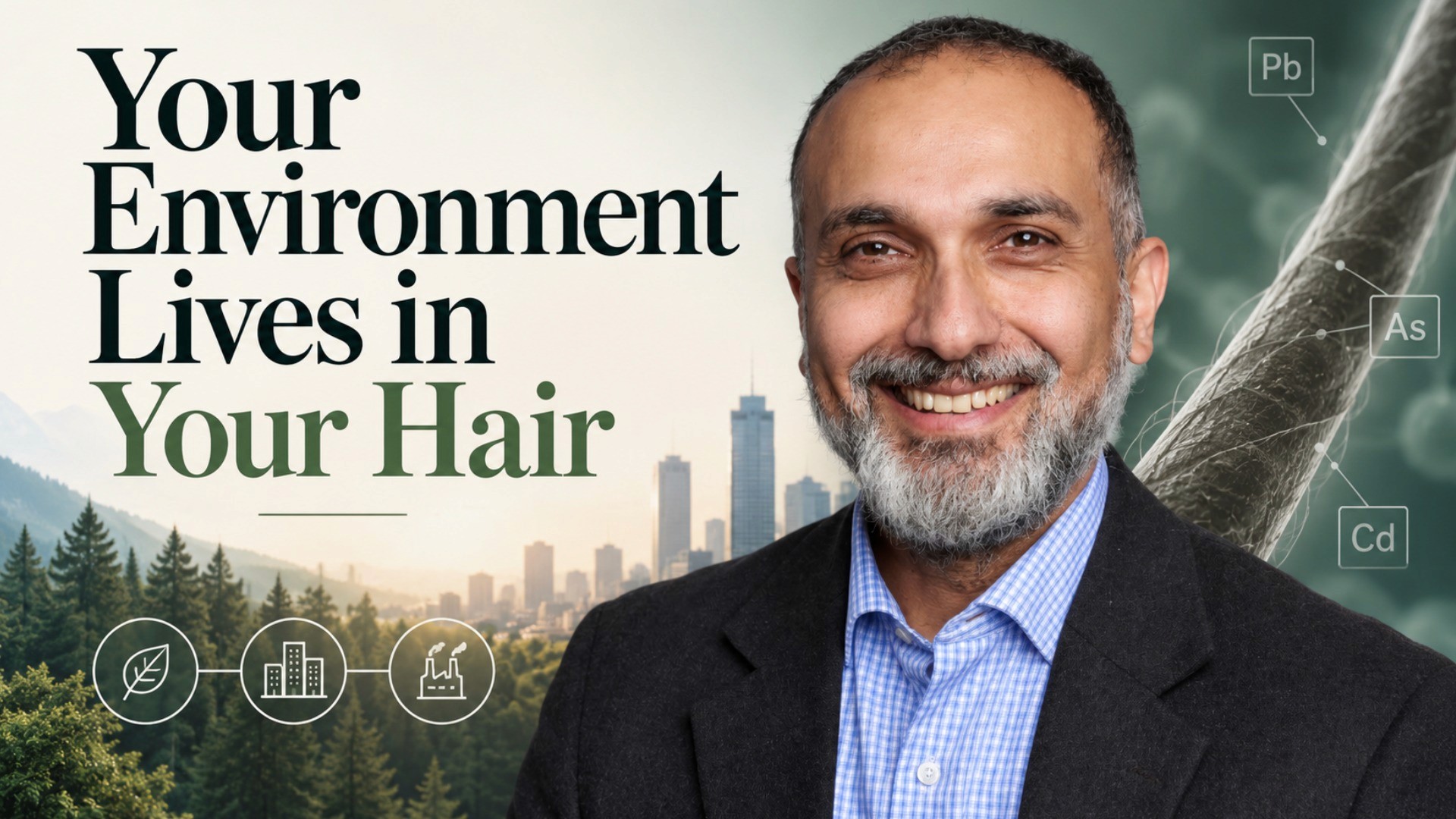
The idea started with a tree stump. As a PhD student, Manish noticed a damaged growth ring and wondered whether human tissue kept a similar record. It turns out hair does, logging a new layer roughly every hour. To read it, his team built robots that straighten the hair and slice it open lengthwise, then use lasers to analyze the inner core while leaving surface contamination behind. From one centimeter of hair, LinusBio can take up to 1,000 measurements across 10,000 molecular signatures. Manish shares what that data has already revealed, from a young athlete's recurring arsenic exposure at a community center to the spike in toxic metals among people affected by the Palisades fire.
The conversation also covers Traced, LinusBio's new $299 at-home test that maps 30 days of exposure across 15 elements, with plans to expand to more than 100. Manish explains why the rhythm of a biomarker like cholesterol may matter as much as its level, how the company uses AI and ideas borrowed from music theory to make sense of millions of data points, and why he wants a hair test to become as routine as a blood draw. Learn more at traced.life.
Episode Resources:
Banter and Vacation Catch-Up
Dr. Tim Showalter:
Morning.
Dr. Trevor Royce:
Good morning, Tim. Welcome back.
Dr. Tim Showalter:
Thank you. I'm feeling pretty fresh. I recommend for anyone who can a week in Mallorca. It's just the best.
Dr. Trevor Royce:
Tell me more.
Dr. Tim Showalter:
Lots of really beautiful areas, great food, great people, beautiful beaches. I will say, if I had some notes, it was super hot, and it's a little stressful driving and parking in particular because it's super crowded. But it is just a magical place, and I can see why it's so crowded.
Dr. Trevor Royce:
The home of Nadal?
Dr. Tim Showalter:
Yeah. We were on the other side of the island, unfortunately. Next time I want to go do some paddle training at the Rafa Academy.
Dr. Trevor Royce:
Paddle? Paddle?
Dr. Tim Showalter:
Paddle? Nobody knows. I think in my area, to distinguish it from paddle tennis, I'll call it paddle.
Dr. Trevor Royce:
I trust you. You're the expert here.
Dr. Tim Showalter:
Well, I'm excited to get back in it. Should we hop in?
Introduction: HealthTech Remedy and LinusBio
Dr. Trevor Royce:
Let's do it. We have a good one today. Welcome back to HealthTech Remedy.
This is the show where physician leaders in health technology break down the stories behind today's most innovative health companies and speak with the leaders shaping the future of care. I'm Trevor Royce. I'm a radiation oncologist and excited to speak with you all today. Tim?
Dr. Tim Showalter:
Tim Showalter, also a radiation oncologist and currently focused on scaling healthcare AI to improve patient outcomes.
Dr. Trevor Royce:
Tim, one of the most fun and satisfying things about doing this podcast with you is putting brain space into thinking about things that otherwise you wouldn't necessarily come across or think about. This company is just fascinating, and I think it falls squarely in that bucket.
I'm talking about LinusBio. This is a company trying to measure something that healthcare has historically struggled to capture: the impact of our environment on our own biology over time and what the implications for some of those exposures might be.
This company grew out of research led by Dr. Manish Arora at the Icahn School of Medicine at Mount Sinai. It uses technology to analyze the molecular and elemental patterns combined within strands of hair, the broader goal being to develop biomarkers for complex diseases and provide a longitudinal view of these environmental exposures.
Dr. Tim Showalter:
Yeah, I love the story for LinusBio. It's really going to be exciting to talk to Manish. I just love that he is an academic, someone who's really involved in research and knows the science well.
I'm excited to unpack some of the science with him because there's a lot about this that's pretty new, likely to both of us. It's great to see him stay at the forefront of science and also help bring this technology to patients and consumers.
The most recent news for LinusBio is that they launched Traced, which is a direct-to-consumer wellness test that analyzes a few strands of hair and reports approximately 30 days' worth of exposure patterns across 15 elements. These include potentially toxic elements—lead, arsenic, cadmium—the usual suspects.
I understand that their pipeline will also add additional elements and other findings as part of the analysis. The basic idea of this 30-day window is that a lot of other specimens, like blood and urine, are just snapshots in time. The idea here for hair is that you can get a longer storyline about exposure, more like a video clip instead of a photograph.
Dr. Trevor Royce:
I totally agree. A couple of really interesting things about this approach stand out. One is it's always exciting to think about a whole new data modality in precision medicine that has been either unrecognized or underutilized.
To your point, we always think about blood or urine markers. In the case of hair, maybe DNA sequencing is common. But this goes well beyond that in terms of capturing molecules based on what you've been physically exposed to.
Mapping that over time—if you live in an area with bad air quality and there's a lot of smoke because there are forest fires nearby—presumably that type of information will be captured over a long timeline. Then you wonder, how is that associated with different diseases and outcomes in your overall health? It's much more than a consumer wellness company.
Dr. Tim Showalter:
Yeah, and I think of all the focus we give to buying organic foods, washing fruit, and drinking from BPA-free plastic products. It's really true that we expend a lot of brain space on this.
I think there is an interest, and I expect there's a market, to monitor that over time. People can take interventions, maybe change their diet or their activities, and monitor how their readout from this test responds.
Dr. Trevor Royce:
Another key piece of this precision medicine tool, as they're calling it—and I think that's an appropriate way to frame it—is the direct-to-consumer angle. Those who are interested or worried about exposures they might have had can directly order this test, as opposed to going through a payer-based laboratory pathway.
Dr. Tim Showalter:
Before we dive into more discussion about the company, we should also state that this is not their first product. They're more than a consumer wellness company focused in this space. They have an additional product called ClearStrand ASD, which is a prescription laboratory test focused on assessing for autism in children.
I know that they have a pipeline looking at additional biomarkers. It's driven by a real focus on environmental health and diagnostics. There's clearly a focus on meeting patients and consumers where they are and providing the right insights.
Dr. Trevor Royce:
What is also useful in terms of framing this discussion or setting the table is thinking about classic examples of environmental exposure. It's been increasingly evident in the lay news.
Wildfires come to mind; every summer we have this story. Certainly in LA, there was a ton of wildfire smoke coming from our northern neighbors in Canada. Asbestos, obviously, is a classic environmental exposure that is well linked with things like cancers and mesothelioma.
Lead and water contamination are other examples. Locally in Durham, a playground was shut down recently because of high lead levels in the soil. The Flint water crisis comes to mind, too. There are these exposures out there from prior eras of industrialization, raising questions about how they impact our health and conditions like autism.
Dr. Tim Showalter:
I would add one other thing: people are talking about peptide maxing and all these supplements. When you get into that space, a lot of these non-prescription wellness products raise concerns about quality, the manufacturing process, and how much third-party testing validates them.
It's possible that you could have wellness-focused people using this to monitor ingested supplements and ensure there are no contaminants.
LinusBio rolled out the Traced test just this summer, in July, as a $299 direct-to-consumer wellness test available throughout the United States. Currently, it focuses on 15 elements. That price point is on the higher end, but for many wellness-focused people, they may see enough utility in it for longitudinal assessments.
Why Hair is Unique for Precision Medicine
Dr. Trevor Royce:
It's worth spending a little bit of time on why hair is unique and why that would be a novel focus for personalized medicine.
The actual amount of hair sample that you need to submit is pretty minimal—around one and a half inches. That provides a longitudinal record since hair grows over time. It's easy to access, everybody has hair, and it has external exposure where environmental elements can be detected on the sample.
Dr. Tim Showalter:
I'm sure there are some interesting, nuanced questions. We're both middle-aged men—what about our friends who are balding? I think they probably have enough hair to provide a sample. I also know there is guidance about dye or color-treated hair.
From reading details about the test, it sounds like a lot of these technical challenges have solutions in terms of how the specimen is handled. The most analogous thing I can think of is the rings of a tree, seeing the story over time. It's really this idea of being able to take a longitudinal look.
Dr. Trevor Royce:
That's the core premise. The leap then is bridging the gap: how do you know what you're finding on this hair is clinically relevant?
You could have a lot of interesting information, but how do you know that it's actionable information that will help your health? And two, how do you prove that association is real, that whatever signal you're detecting on that strand of hair will ultimately be a contributor to pathology down the road?
Dr. Tim Showalter:
Some of the challenges you have to untangle—see what I did there, untangle?—include external exposure versus something ingested or absorbed within the body. There are also biological conditions that come from the host that could influence this. That's the scientific challenge that LinusBio has to address.
Dr. Trevor Royce:
As a health services researcher, in the back of my mind, it unlocks a whole category of questions worth answering, seeing which of these factors are associated with whatever outcome or disease you have.
Dr. Tim Showalter:
From a consumer perspective, this is where thinking about it as a wellness test is useful. You're going to get some signals where, for healthy patients—the worried well, as they're often called—some findings are preliminary and not a sign of a looming clinical condition.
Understanding the logical next actions that will improve health is going to be something that varies from person to person and can be complex.
Dr. Trevor Royce:
Totally. Super fascinating area, and there's a lot to discuss here. Any final thoughts before we transition to the interview?
Dr. Tim Showalter:
I want to hear about the science. I want to understand what happens when the hair gets into the lab and how they deal with it overall.
I really want to hear Manish explain that in some detail so I can start to wrap my head around it. I'm sure there will still be areas that are above my mental capacity.
Dr. Trevor Royce:
I'm glad you brought that up because we have barely scratched the surface on the technical challenges they've solved. There's robotics involved, lasers involved, and cutting open the strand of hair in a way that allows you to analyze these exposures. We'll definitely have to hear more on that front.
Interview with Dr. Manish Arora
Dr. Tim Showalter:
All right. Looking forward to our interview. Stay tuned.
Welcome back to HealthTech Remedy. We have our guest today, Dr. Manish Arora, founder and CEO of LinusBio. Manish, welcome to the podcast.
Dr. Manish Arora:
Tim, pleasure to join you, and thank you for having me on your show.
Dr. Tim Showalter:
I'm excited to dig in. You came from an academic background and have focused on studying how environmental exposures affect human health. What did you see in the traditional approaches to testing that led you to build LinusBio?
Dr. Manish Arora:
There was this disconnect in the way we approach medical practice. We all know the age-old argument of nature versus nurture, and in modern clinical practice, almost everyone accepts it's actually both nature and nurture.
Then we had this massive breakthrough in sequencing the human genome, and all of medicine became genomic-centric. I saw this missing piece in the field we call environmental medicine.
In our clinical days as doctors, we got very little environmental information. We know the environment is important, yet when we treat patients, we barely ask them about their smoking habits or similar factors. That's what I wanted to fix: bring about clinical tools from the realm of environmental medicine that we can use to help people stay healthy.
Defining the Exposome vs. Genomics
Dr. Trevor Royce:
This concept resonates with me tremendously because it makes so much sense that genes are just where we start, but there's so much that happens downstream from that.
When Tim and I interview companies, this is one where my mind was blown by what you're working on: this idea of an exposome. Can you define that, tell us what it means, and put it in the context of genomics?
Dr. Manish Arora:
When we first started studying genes, we started with one or two genes—that was genetics. It became genomics when we started studying the totality of our genome.
It's a similar idea with the environment. Twenty-plus years ago during my PhD, I was studying lead exposure, just one chemical. But in everyday life, we get exposed to thousands of chemicals. I became an expert in lead, somebody else became an expert in something else, and no one was studying the totality of these exposures.
Gradually, the profession moved towards looking at the totality of your overall exposure over a lifespan. Our genes are static; since conception, they're the same with a few epigenetic changes. Our environment is changing all the time. That's what the exposome covers: the life-course totality of environmental exposures that impact your health.
Traced: A Monthly Molecular Movie of Exposures
Dr. Tim Showalter:
That's an interesting concept. As an oncologist, I get asked all the time whether a certain exposure contributed to why someone got cancer. These are really tough questions to unpack. Bringing it to the consumer level, people have questions and want to know more.
You recently launched a direct-to-consumer product called Traced. What is that designed to answer for a consumer that a standard test can't, and how are people finding it useful?
Dr. Manish Arora:
The new test is called Traced, and it's on our website, traced.life. This is the first test that will, from a single sample collection, provide you an entire month's worth of exposure history.
Let me contrast that with standard testing. If you do a blood test or collect urine at home, freeze it, and ship it on ice, you are still getting just a snapshot of your exposure at that specific time. But our environment changes every day. The exposures you experience on your way to work are completely different from the exposures you have while sleeping at home at night.
From a single strand of hair clipped with scissors at home—no pain, no pulling—we give you a 30-day, daily profile of exposure. We are starting off with 15 elements, including toxic metals and essential nutrients, but we will grow this to over 100 in the next few months. That's what Traced is.
Dr. Trevor Royce:
When you say 100, you mean measuring 100 different substances within that strand of hair?
Dr. Manish Arora:
Exactly. To be frank, we are already close to 200, but we're going to release them in small batches so we can communicate with our clients in understandable, bite-sized pieces.
All of this is measured in hair and collected at home. We don't need several hundred hairs; we just ask for about five strands. You can bring your children along on this wellness journey.
I'm the father of triplet daughters. The day I have to take them for a blood test, my whole day is gone. But with this, I can collect hair while a young child is sleeping. All we need is a centimeter of hair to map an entire month of exposure.
Because we humans lead rich lives, our exposures on the weekends are different from our exposures on weekdays. We can give you guidance based on your routine, not just an assumed average from a single measurement at an annual wellness test.
Real-World Impact: Tracking Exposures and Remediation
Dr. Tim Showalter:
What are you hearing from people using this? Have you heard from clients who are modifying their behaviors or health practices based on the results?
Dr. Manish Arora:
Absolutely. I'll share a few examples without delving into personal details. For one young client, their mom had a chat with me after seeing the results. They had an exposure every five to six days to arsenic, which is a bad chemical to have in your system. Most Americans actually have very low exposure.
We talked back and forth, and it turned out this young man plays basketball at a community center undergoing renovation. He was exposed to dust and a contaminated water supply. Immediately, there was action to be taken.
No genomic test gives you something you can act on yourself the moment after you get it. You know a lot about your genes, but you can't change them yourself. Immediately after doing this test, you can take simple steps that cost almost nothing.
Another example: a group of people affected by the Palisades fire in California came to us. They said, "We don't know what our exposures were before the fires because no one's collecting blood routinely. Can you measure our hair and tell us what our levels of toxic exposures were before the fire, during the fire, and after the fire?"
We finished that project, and as soon as the fire hit, toxic exposures shot up. Because blood forgets, if you measure blood today, you don't see that signal. The application of the Traced test is wide: it can be applied in clinical medicine, in wellness journeys, and in disaster response.
Dr. Trevor Royce:
What's unique about this is you can measure exposures over a timeline duration. It's not a one-time event; you can see how an intervention to reduce exposure improves future testing. Is that right?
Dr. Manish Arora:
Exactly. If you think of a blood test as a snapshot, what we are creating is a molecular movie.
The aha moment for me happened more than 20 years ago as a PhD student. I saw a tree that had been cut down, and I looked at the annual growth rings. One of those rings was very garbled and thin. I thought, "Something must have happened—there might have been a drought, or the tree got sick."
That was the moment I said, "What if there are growth rings in human tissue? We could build a biologic hard drive that allows a continuous readout like a wearable built into you." Instead of a smartwatch, this grows out of you.
Hair has growth rings that you can visualize through computational methods every hour. If you give me a centimeter of your hair, I'm taking between 800 to 1,000 measurements. It's like getting a blood test every hour over a month without having someone wake you up to draw blood. Your body is doing it for you.
Understanding that there are growth rings was one thing, but analyzing microscopic rings you cannot see with your eyes presented immense challenges. That was the next part of the journey in building LinusBio.
Dr. Trevor Royce:
A nice thing about hair is you don't have to charge it every night like an Apple Watch. It's always with you and records that information no matter what.
Dr. Manish Arora:
That's exactly right. It's not like a smart ring telling you that you had a terrible night of sleep because sweat got between the ring and your skin on a hot night.
If your audience could see me, I don't have much hair left on my head. But I can still grow one centimeter at the back of my head if I put my mind to it. That's why we didn't want a test asking for 300 or 500 strands; I just want one or two.
The scientific journey wasn't easy—we had to build robots and lasers—but it has been very satisfying.
Dr. Trevor Royce:
I'd love to hear a bit more about a specific use case. I just got back from Sequoia National Park, where they have 2,500-year-old trees. I had that exact thought looking at tree rings: you can tell when big forest fires occurred by differences in the rings.
You mentioned the firefighters in Southern California. Can you tell us how your technology contributes to their health and well-being?
Dr. Manish Arora:
To understand how something impacts your health, you can't just measure exposure while the event is happening. You need to understand your baseline, and each of us has a different baseline. Ideally, we would collect information all the time, especially when we feel healthy.
With the Palisades fire, some people had long hair, so we tracked back in time before January 2025. We have ways to calculate growth rates in hair, so within a window of plus or minus two weeks, we identified when the fire started and analyzed the elemental levels.
Levels shot up spectacularly after the fire started for chemicals like nickel, lead, and even zinc and copper. Suburban structures are full of metal, from plumbing and furniture varnish to house paint.
As levels shot up, we mapped them to the dates of the fire. Even after the fire stopped, levels in the body remained high for many months before trending toward baseline.
If you examine someone now, blood has forgotten. But with hair, we see which elements went up. Backed by decades of studies in toxicology and environmental health, we know the health effects of these chemicals.
We can provide clinical guidance through medical colleagues to say, "You are at higher risk for this," and help them take remediation steps. For many, their homes are still contaminated, and because one cleaning strategy doesn't work for every chemical, they need targeted guidance.
The Science: Slicing Hair with Robots and Lasers
Dr. Tim Showalter:
This is fascinating. The assays sound quite complex to run. Could you give us a glimpse into that process?
Dr. Manish Arora:
When we first realized hair had growth rings, our first challenge was straightening curly hair. When I had hair, it was quite curly. Lasers move in a straight line, and no matter how hard we tried with our hands, we couldn't get the hair straight enough.
So, we built robots. As a clinician with a PhD in environmental sciences, I had no engineering training. I worked with world-class robotic engineers in Japan who built robots that take the thinnest hair, make it perfectly straight, and stamp it on a microscope slide.
The next task was even harder: slicing hair lengthwise, opening it like a book rather than cutting it cross-sectionally. That isn't something human hands can do, so we built robots for that.
When the robot opens the hair, the core contains what I call the good stuff: information captured from blood and stored in an incremental archive. Imagine a train going through a tunnel where each car fills with information and remembers its own data without mixing it up. That's how hair grows.
We use a laser to go into each train car—each growth ring representing one hour—and release the molecules. At each ring, we measure more than 10,000 molecular signatures.
From a centimeter of hair, we get 10 million biochemical data points. Compared to a wearable ring measuring five or six metrics, we are building a molecular map over time. That has never been done in human history, and I feel privileged to look at data like this.
Separating Internal Biology from External Contamination
Dr. Tim Showalter:
That is remarkable; I'm blown away. Straightening the hair and slicing it longitudinally seems challenging enough, but hair is also exposed to surface compounds. How do you distinguish what is biologically integrated through the body from residual surface contamination?
Dr. Manish Arora:
That was the core challenge. Many past hair studies that analyzed clumps of hair produced data skewed by contamination. If you're a non-smoker walking past someone smoking, smoke deposits on the outside of your hair, and you test positive no matter how much you wash it.
That's why we slice the hair open. The outer keratin layer captures external contamination, but it is fairly impervious, so contamination doesn't seep into the core.
When you open the hair, we analyze only that inner core. We are looking at a fraction of the thickness of an already thin hair strand and mapping it lengthwise. It has to be done with robots and lasers, but excluding the outer layer eliminates the contamination.
Dr. Tim Showalter:
Does the laboratory see variation when handling different hair types, whether curly, straight, different colors, or varying consistencies?
Dr. Manish Arora:
Surprisingly, chemical absorption doesn't vary much between curly and straight hair, or across natural hair colors like black, white, red, or blonde.
Synthetic coloring agents, however, are a concern. We ask clients to wait a few weeks before their next coloring cycle and provide hair closest to the scalp because it's the freshest and least processed.
I have triplet teenage daughters, and their floor is covered with dozens of styling tools. We have to ensure hair hasn't been overheated. Taking the hair closest to the scalp ensures minimal heat and color treatment.
Dr. Trevor Royce:
To be clear, all these gray hairs my kids are giving me are analyzable on your platform?
Dr. Manish Arora:
Yes, absolutely. We love gray hair. I used to have gray hair before I lost it, Trevor, so it can get worse and you will miss it!
Dr. Tim Showalter:
That's what triplets do to you, right?
Dr. Manish Arora:
Remember girls, Tim said that, not me!
Right now, we focus on scalp hair. In the future, we will look at hair from other parts of the body for individuals with no hair on their scalp. We don't want to leave anyone out.
This is a non-invasive gift from nature: no freezing, no chemical reagents in the tube, and none of the messiness of urine or stool samples. The vision is for this to be as common as a blood test. In five to ten years, when I ask a room of people how many have had a hair test, I want every hand to go up.
Measuring Dynamic Biological Rhythms
Dr. Trevor Royce:
Two quick technical questions: you need a minimum of one centimeter of hair, but can you get more information from longer strands?
Dr. Manish Arora:
Yes, longer strands record more exposure history. But to be a good scientist, the longer the hair, the more factors we must account for.
If you shampoo every day, hair grown a year ago has been through 365 wash cycles, whereas new hair has only gone through one. We've developed computational methods to adjust for this, but we remain cautious with very long hair.
For most people, we recommend sending one centimeter of hair four times a year. That provides data across winter months, all four seasons, weekends, weekdays, and holidays. That cadence builds an exceptionally accurate map of your health.
Dr. Trevor Royce:
You focus specifically on exposures, but hair also contains nucleic acids, RNA, and genomic material. Is there additional information you could tap into down the road?
Dr. Manish Arora:
If you pluck the hair to get the follicle, you can access genomic information from the bulb beneath the skin. That makes collection painful, and saliva tests already capture that easily at home.
However, we don't just measure environmental exposures. We also have robust measurements of cholesterol and lipids.
As medical practitioners, we've always told patients whether their cholesterol is high or normal. But what if you asked, "What's the rhythm of my cholesterol?" The rhythm is just as important as the concentration.
It's like music. I'm a Springsteen fan and a terrible musician. If I sing a Springsteen song terribly, turning up the volume doesn't fix it. Yet in medicine, if cholesterol is off, we just increase or lower it. We should be asking how to fix the dynamic rhythm.
We measure 10,000 molecules, including endogenous lipids, essential nutrients, and toxic exposures like microplastics, PFAS forever chemicals, and pesticides. We start by delivering this in accessible, 15-element panels through our Traced test.
Translating Complex Data into Actionable Insights
Dr. Tim Showalter:
Whether clients are on a wellness journey optimizing nutrition or concerned about dangerous exposures, they often need actionable guidance or physician follow-up. How do you manage that at MyMispire?
Dr. Manish Arora:
We want to deliver actionable insight, not just raw information.
If you look at the sample reports on traced.life, we don't just show exposure patterns and leave you to figure it out; we provide simple insights at the end. Decades of peer-reviewed research show how certain chemicals move together.
For example, if an exposure looks like it stems from a water supply, we suggest looking beyond standard filters to reverse osmosis systems, which are affordable and easy to install.
If a mixture comes from traffic dust, the solution might be taking your shoes off in the mudroom or resealing drafty windows in older homes. We provide actionable steps.
When my daughter had a full genetic screen for neurodiversity, I came home frustrated because there was nothing I could do differently based on that test. With Traced, you can take immediate action yourself without navigating a complex healthcare system.
Integrating AI, Computer Vision, and Music Theory
Dr. Trevor Royce:
We would be remiss if we didn't touch on AI. How does AI fit into your platform, and how will it impact your future?
Dr. Manish Arora:
AI is at our core; we describe ourselves as a physical AI and robotics company. Analyzing this data would not work without cutting-edge AI.
When hair comes out of the tube, our first challenge is identifying growth direction: is it mounted left-to-right or right-to-left? Reversing that invalidates the reading. We coded thousands of hair images to build computer vision tools that identify growth direction from microscopic features invisible to the human eye.
Analyzing 10 million data points across 1,000 time points with 10,000 molecules each required novel tools. We turned to music theory: like an orchestra, every instrument must be synchronized, and AI identifies what is falling out of sync.
Lastly, we are building customer-facing AI. Instead of reading a five-page report, an app can deliver a 30-second micro-learning check-in over morning coffee, pointing out cyclical exposure patterns. Because public AI models scrape the broader internet, we train our AI strictly on our unique, curated datasets.
Looking Ahead: The Future of Environmental Health
Dr. Tim Showalter:
Trevor and I could talk about this for much longer, but as we close, I have a two-part question. First, how can listeners access this technology today? Second, what should we look for from LinusBio over the next two to three years?
Dr. Manish Arora:
Visit traced.life. We provide a simple explanation of the 15-exposure test, along with sample reports and direct access to our team for questions.
Looking ahead, we want to provide an increasingly comprehensive picture of your environmental health. While we test 15 elements today, we can already measure 150 in the lab and will continuously roll out new panels to capture emerging industrial chemicals.
Today, most Americans only monitor home temperature with a thermostat and fire risk with smoke alarms. We know very little about the chemical exposures inside our homes, and we plan to change that.
Dr. Trevor Royce:
This has been an amazing conversation, and we'll definitely have to have you back—especially for Bruce Springsteen karaoke. Listeners can head to traced.life to learn more.
Dr. Manish Arora:
That's correct.
Dr. Trevor Royce:
Thank you for your time, Manish. It's been a pleasure.
Dr. Manish Arora:
Thank you both. I really appreciate it.
HealthTech Remedy is produced by Podcast Studio X and is powered by BuzzyPod.