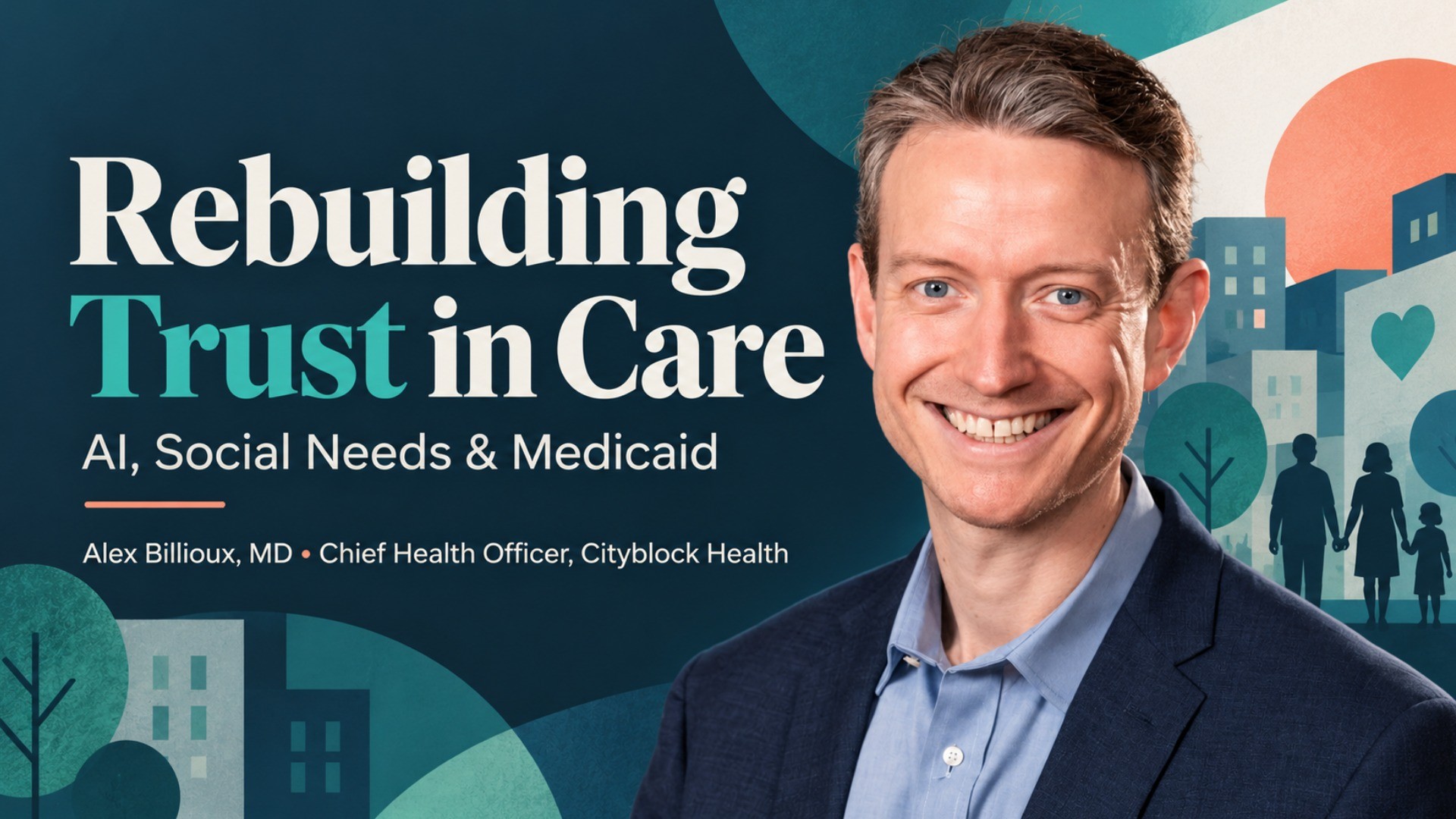
Three-quarters of the Medicaid members Cityblock Health serves don't trust the health care system, so the value-based care provider builds its model around earning that trust. On this episode of HealthTech Remedy, hosts Dr. Trevor Royce and Dr. Tim Showalter ask Cityblock's Chief Health Officer how the company engages the people the health system fails, and how AI helps it do that for over 100,000 people across 11 markets.
Dr. Alexander Billioux is the Chief Health Officer of Cityblock Health and an internal medicine physician. Before Cityblock, Dr. Billioux practiced at Johns Hopkins in East Baltimore, worked at the CMS Innovation Center on payment models that bring social care into clinical care, led Louisiana's Office of Public Health, where a hepatitis C subscription model led to nearly 20,000 Medicaid members and incarcerated people being treated, and spent five years at UnitedHealthcare, most recently as Chief Medical Officer for its government programs.
The conversation covers why Cityblock leads with community health partners, people from the communities it serves who start with members' unmet social needs; how engagement of often 60-plus percent in the first year, backed by a promise to put a physician on the phone within two minutes, 24/7, helps members avoid unnecessary emergency department visits; and why Cityblock uses AI not to cut headcount but to bring precision medicine to population health, with ambient scribes and next best action that free clinicians to spend their time with patients.
Resources:
Back from Sequoia National Park
Dr. Trevor Royce: Hey, Tim, good morning.
Dr. Tim Showalter: You feeling rested from vacation?
Dr. Trevor Royce: Oh man, just got back. Great vacation. We went to Sequoia National Park, which is pretty cool. They have trees there 2,500 years old. Even older than HealthTech Remedy podcast.
Dr. Tim Showalter: Amazing. That's right. And I guess not all the kids you brought are older than HealthTech Remedy podcast, unfortunately.
Dr. Trevor Royce: That's true actually, that's true. That's right. This podcast is older than my youngest, so this would be my fifth child.
Dr. Tim Showalter: Yeah. Yeah. Amazing. And the pics looked really awesome. Looks like you had a lot of fun. It must have been pretty tiring.
Dr. Trevor Royce: We had a great time. It was a lot of fun. It was tiring, but that's what vacations are all about with little kids.
Dr. Tim Showalter: Alright, well, this'll be the first recording since vacation, so let's hop in and do it.
Is Cityblock Health a tech company or a care company?
Dr. Trevor Royce: Let's do it. I'm fresh and ready. Welcome to HealthTech Remedy. This is the show where three physician leaders in health technology break down the stories behind today's most innovative health companies, and we speak to the leaders building the future of care. I'm Trevor Royce. I'm an oncologist and researcher focused on informatics and AI diagnostics.
Dr. Tim Showalter: And I'm Tim Showalter, a radiation oncologist and former med device entrepreneur now focused on scaling AI technologies that improve health care outcomes. And today, we are discussing Cityblock Health. This is a technology-enabled care provider that focuses primarily on Medicaid and dual-eligible populations. Cityblock merges primary care, behavioral health, overall care management at the population level and support for social needs through clinics, virtual care and community-based teams, with much of the model built around value-based payment, and I'll say taking on some of the most challenging problems in health care overall.
Dr. Trevor Royce: Yeah. I'm excited about discussing this company and certainly the interview, where they've been very intentional to address, like, a very core societal need and make it a financially viable business as well in this crazy world of public versus private health care that we have in U.S. Excited to see how they try to solve that and have a viable entity that can treat some of these hardest to manage and treat patients with some of the more complicated aspects of care.
Dr. Tim Showalter: Yeah, I mean, I've always been struck in practice that so much of the health-related variables are hard to control from a brick-and-mortar office, for sure. So nutrition or accessing social services or behavioral health, it's often kind of challenging from a typical hospital setting. And it's pretty remarkable that Cityblock is taking on this complexity and serving the behavioral and supportive care needs for patients in addition to traditional medical care.
Dr. Trevor Royce: Yes. And then, you know, underlying all this, and this is a core theme that we've touched on in a number of prior episodes, is, you know, this idea of value-based care, moving beyond a fee-for-service model where you're just getting paid for the care delivered, but actually getting compensated for the outcomes, the quality of the care, and trying to move away from this sort of consumption-driven health care system, and that can help address some of these, again, our hardest-to-reach and hardest-to-treat patients.
Dr. Tim Showalter: Yes. I mean, I think if you're moving away from the traditional fee-for-service model, which is based on identifiable conditions with a defined episode of care, you really are going to need a fundamentally different care model. And I think that's where Cityblock's structure comes into place. I think you can ask yourself whether it's a tech company or a health care provider. Think, on the one hand, it's reinvented the care model and is using a lot of time and technology. So you could call it a health tech company. On the other hand, there are directly employed care teams that are out there delivering medical care, and so it's really a merger of both. It's where you're seeing technology to provide leverage and make it possible to take care of patients in these challenging environments and to handle a large population, but ultimately, people and relationships are the product offering, essentially.
Dr. Trevor Royce: Yes. I mean, it sounds almost trivial or meaningless to make that distinction, tech versus health care delivery company versus a technology company. But I think it actually is really important, and my sense is that, you know, their ethos is health care first. And I think that's a critical approach. Otherwise, you risk sort of losing the sight of your mission, which is to improve the health of your users at the end of the day, and I definitely have the sense that they are a health care provider first mentality. And then that's enabled by their technology support.
Social needs, outcomes and AI at Cityblock
Dr. Tim Showalter: Yes. And I think we've covered a few companies where part of the offering is reaching patients who might otherwise not be accessing care consistently or might have trouble receiving it. And I think that part of showing up directly and being patient first is really key to building trust and engagement overall. I'm still reflecting on how Cityblock is delivering transportation, addressing housing instability, food insecurity and other social factors, which are really broad, and I think a lot of us don't think of it as part of the medical treatment plans, but is an important part of health overall. And it does address the questions of how much responsibility should health care organizations be assuming for addressing these needs?
And what's within scope? What's outside of scope? And I think Cityblock's general approach has been to take a broad lens on that, and so it's great to see. It does seem like in the primary care setting, when you're trying to move the needle on chronic conditions, that it's a really important part of the overall strategy.
Dr. Trevor Royce: Yes. I mean, the reality is the addressing these social needs and sort of infrastructure needs for an individual's health matter way more than all these interventions that we would like to think are, you know, the things that are actually helping. So it's critical if you're moving towards a value-based system that you address these societal issues and the infrastructure thrown into patients to improve their health, no doubt about it. And as you mentioned, transportation, housing instability, food insecurity, these are by far and away the greatest drivers of health, well beyond things like genetics and coronary interventions, which are all after the point of having developed the pathology.
Dr. Tim Showalter: Yeah, it's pretty intensive when you think about it, because there are a lot of levers that they're pulling. So I think for the model to be sustainable, Cityblock's gonna have to show that these diverse interventions deliver on reducing hospitalizations, reducing the chance that a patient's gonna end up getting care in the emergency room setting, which would drive up costs, obviously, for the payers. And so, you know, this model really hinges on making sure that outcomes can be improved in that setting through a multi-pronged approach.
Dr. Trevor Royce: Yes, absolutely. And we'll have to hear from Dr. Billioux, who is their Chief Health Officer, in the interview about kind of how they measure success. And, you know, it's always tricky when you're focusing on quality, what your metrics are for success, and that you're not just sort of gaming a system to meet those metrics, but you're actually fundamentally improving the health of your, you know, your users.
Dr. Tim Showalter: Yeah. I also want to explore more about how they're using AI and data overall to drive the health care team for understanding what are the important next steps for managing a population. Obviously, they've got access to a large amount of data, claims data, clinical data, operational data. And being able to take care of a large-scale population, often including a hard-to-reach population, really depends on being able to identify the patients who need the most attention and directing the care team towards that particular patient, and understanding what are the strategies that are gonna be engaging and making it feel personal in a way that uses technology as well as humans at the front line to deliver the care in the most compassionate way possible.
Dr. Trevor Royce: Yep. And they've reached a, you know, kind of an impressive scale for this. We should cover a little bit of how much they've grown, meaning, like, I think they're serving over 100,000 members. They've raised almost $1 billion, and some of these contributors are, you know, very prominent growth funds like General Catalyst, Tiger Global Management. They've reached a scale where they can really address some of these big issues, and clearly, like, there is a model there where it's a viable business.
Dr. Tim Showalter: Yes. And I want to know, what are the learnings for more traditional health systems and medical groups? Are there elements of this that can be brought into a traditional model? So it'd be interesting to draw conclusions about how each of these more complex interventions at the social services and nutrition level translate into improved patient outcomes.
Dr. Trevor Royce: Absolutely. Any other core themes you want to touch on? Yeah.
Dr. Tim Showalter: Well, I think we've highlighted some themes to cover with the Chief Health Officer of Cityblock Health, Dr. Alexander Billioux. So I guess we'll move ahead to the interview portion.
Dr. Trevor Royce: It sounds great. Looking forward to it.
Alex Billioux's career and the Medicaid problem
Dr. Tim Showalter: Our guest today is Dr. Alex, Chief Health Officer at Cityblock Health. Alex, welcome to HealthTech Remedy.
Dr. Alexander Billioux: Yeah. Thanks, Tim. Glad to be here.
Dr. Tim Showalter: And I did want to go back. I think you've got a really interesting origin story and a lot of really compelling experiences that obviously come to bear for your role at Cityblock Health. So I'd love to really start there and hear a little bit more about your work as a physician, public health leader, policymaker, health plan executive, and because you just give our listeners an overview of your career arc and maybe give us some perspective on how those experiences shape your view of what you're working on right now.
Dr. Alexander Billioux: Yeah, sure. So that's a kind interpretation of what can look like a very scattered career up to this point. But I think the sort of the unifying theme here is I'm an internal medicine physician. And the focus of my career has really been why, you know, the health care system consistently fails the people who need it the most and what I can do to try to fix that. So as you noted, like, I started in academic medicine practicing in East Baltimore at Johns Hopkins. I've done international work working on tuberculosis diagnosis and treatment in Uganda. I had a really fun few years at the CMS Innovation Center working on population health-focused models tying payment and incentives to help integrate social care and the social barriers that our members face into clinical care, which is now much more common since that work. Also worked at the state level, leading public health in the state, where we, you know, tackled things like COVID-19 but also did ambitious things like launching a hepatitis C subscription model that really changed the way that we thought about who could access, you know, life-changing medications and resulted in nearly 20,000 people in Medicaid and incarcerated individuals being treated. And prior to coming to Cityblock, spent the last five years working at UnitedHealthcare, initially leading their social care programs, that's strategy as well as capabilities, and then over the last year and a half there was the Chief Medical Officer for their government programs. And I think all of that experience and those gaps are really what drove me to Cityblock, which is, I think, an organization that is really focused on actually building a care delivery model that is designed for those people who are failed by the health system and in addressing the specific ways that they're failed, both trust, engagement, access, but also integration of services.
So it's been a really fun time being here.
Dr. Tim Showalter: Well, it's amazing to see you in that role. And I just, like, reflect a little bit for the listeners that, for those who don't know, Johns Hopkins University is, like, tremendous both for medicine but also for public health. And so obviously, it sounds like your background and your bona fides for this space are pretty remarkable. And your story seems pretty linear and logical from this perspective. I'm imagining it didn't always feel that way, but it certainly seems like you're prepared for the job that you've taken on.
Dr. Alexander Billioux: Yeah. Thanks. I think it is easier, you know, as physicians, we spend so much of our life applying for the next role. And I always found that actually very helpful, because it means that at multiple times through your career, you have to reinterpret: what have I been doing? Where am I trying to go? So do think it also helps crystallize, you know, what is the impact I want to have. And again, I think one of the things that really drove me into Cityblock is, at this point, I'm really focused on that last mile, which seems to be the challenge. You know, working at a high policy space, there's lots of things you can do to kind of set the table, but I would say it feels very different to be sitting at the table trying to actually do the work. And I think now, in the current context, with the amazing technology we have access to, it's a really exciting time to be in this position.
Dr. Trevor Royce: Yes. This makes great sense to me. Can you reflect just a little bit on the problem that you're solving for at Cityblock? And maybe for our listeners, put in a little bit of context kind of where we are as a nation and the value-based care story, which has been going on a while.
Dr. Alexander Billioux: Yes. So, you know, I think the problem is also intrinsic to talking about the company. We serve Medicaid, Medicare and dually enrolled individuals. And especially, you know, this company started focused on the Medicaid population, which is the most complex, most underserved, most avoidably expensive, especially when you include Medicare in that population, in the country. So when we talk about these sort of macro discussions about where health costs are going, where health spending is, and, you know, trying to bend the cost curve, certainly, it's a national problem. I can say from my previous public health seat, there's nobody untouched by, you know, the health challenges we have, metabolic disease, outbreaks like right now. But when you think about who's going to be most affected, and then because of the nature of our health system, where the main costs are driven, it's really the people who the health system was not designed to serve, those people in Medicaid and especially dually eligible population.
So Cityblock took a really sort of different position than most start-up companies and said, that's the population we want to serve, we want to start there. The reason it's different is not only is it one of the hardest populations to serve for a variety of reasons, including lack of trust in the health care system, which is well earned, difficulty to engage, but also the margins are really small in Medicaid because it's a historically and persistently underfunded system of insurance. And so over the last nearly decade, what Cityblock has really built is not just, you know, another value-based care delivery model, but one that's really honed on solving a lot of issues that, frankly, the entire population needs, but in one of the most challenging populations to prove those effects.
Can we reach people who are difficult to reach? Can we wrap our model around them rather than create something that they have to come to? And then, you know, does the work we're doing fundamentally change the trajectory of their health and the trajectory of the costs that are being driven, rather, by their poor health?
Building trust with community health partners
Dr. Trevor Royce: Fantastic. Yes, I've loved how you framed that, and, like, it's such an important problem, and I'm so glad that an organization as sort of mature and sophisticated as Cityblock is, like, tackling this. Can you talk a little bit about what the care experience is like, then, for someone engaging with Cityblock?
Dr. Alexander Billioux: Yes, sure. Well, I'll maybe a pre-post, so I'll say, you know, we do a lot of work trying to understand our members. Again, we have a decade of experience, so a lot of this is hard earned, but we also actively try to, you know, research and understand the people we're serving. And I think one of the important things to understand is the population: three-quarters of the Medicaid population we serve, and this includes the duals, don't trust the health care system. So we're talking about a group of people that are not difficult to engage just because of the old, you know, "Hey, it's hard to get a stable phone number for these people," or their, you know, address changes. They actively, you know, don't feel that they trust the health care system, and we're sort of showing up and saying, "Hey, we're here to help," and we're not the first that they've heard to say that.
So a lot of the Cityblock model is very focused on engagement. I think that the key to our success with engagement is leading with what we call community health partners. These are like community health workers. These are individuals from the communities that we're serving who reflect and represent the diversity of the communities we're serving and show that, again, we're putting that sort of, you know, last mile effort into making a real connection that doesn't just come from the standpoint of, "Hey, we're the health system, this is what we get out of you," but trying to understand, first and foremost, what do you need? Leading with their unmet needs, often their unmet social needs, trying to focus on getting those things met, not just because they engender trust, though they do, but also because those barriers are often the things that are critical barriers to their health: lack of healthy food, transportation issues keeping you from going to not just clinical visits, but the places you need to get to, grocery store versus the corner store, places to get out and even exercise.
Addressing those needs makes it easier for us to also help them improve their health. And over time, that helps them feel trust in our model, which is an integrated physical, behavioral and social care clinical delivery system. We deliver care virtually, in person. We have hubs in most of our markets where people can come in and be seen in a traditional visit sense, as well as in-home care that we can deploy either for that kind of longitudinal care or, importantly, as an augment to our virtual urgent care. Our membership are really encouraged to reach to us first when they have a challenge, because we know that in most cases, we can avoid that unnecessary ED trip, which, nobody wants to go to the emergency department, but it also, you know, increases the risk that they get admitted unnecessarily and that we see high downstream costs.
We can do that virtual urgent care 24/7 and, if needed, even deploy somebody to the home, a trained paramedic or EMT that works with our on-the-screen physician to address the needs, keep people stable in their homes and avoid, you know, unnecessary hospital care.
Dr. Tim Showalter: Alex, that sounds great. And it seems like you're solving a really comprehensive set of problems that altogether address health and not just medicine, so to speak. It's a much broader view. And you listed a few things that I, as a fellow physician in the traditional health care system, really struggle with for patients who, like, may need some help with transportation or for other support. They seem like really difficult problems to solve. And I'm curious what the model looks like for members of the care team that are, you know, not just the doctor or nurse that I think most listeners are probably thinking of. Can you give us a bit of a, like, broad overview for what that looks like?
Dr. Alexander Billioux: Yes. I mean, these are really difficult positions. For instance, if we talk about housing instability, I mean, there are long wait lists for public housing, shelters are less than ideal, especially for somebody with a medical condition. So these aren't the kinds of things, though, some of these things are not the kinds of things that we can turn around overnight. But what we do have is a team of, again, community health workers, social workers, our overall infrastructure that's pretty tenacious and works longitudinally with that member. How can we sort of, you know, not only help you with applications, in some cases, if somebody really needs it, sort of accompany you to the offices to get your paperwork in? Because those are the things that could seem like an extra nice-to-have, but they're actually pretty critical for, you know, the actions that we think need to be delivered for our members to happen. So I think there's a lot of appreciation across the clinical team for both the nonclinical and clinical parts of the team that work together in pods, not just for the provider who's tackling the health issues and coming up with prescriptions and plans as traditional, but they're really taking cues from what that community health partner who has the relationship with this individual says about who this person is, how they like to be reached, how we can best engage them.
And again, we've built this experience over the last decade. I think it's a really critical, I'll call it, data set, but it's much more than that, but, like, a data set that then fuels where we've been moving more recently into leveraging that to really supercharge our population health approach using machine learning and AI, because I think that's the key sort of limitation to some of these applications. If you don't know enough of who you're reaching, how you can reach them, what happens when you reach them, I think it's really hard to orchestrate care in the way that we're trying to.
Why engagement is Cityblock's special sauce
Dr. Tim Showalter: That's really powerful. And I know that you've been at Cityblock for about a year. On the subject of patient engagement and trust, what's surprised you the most or really been emphasized during your time at Cityblock?
Dr. Alexander Billioux: So a couple of things. I mean, one, I had never seen a metric of trust in the health care system, despite all of these different sort of positions that I had been in up to this point. So I both anticipated that trust was going to be low, but I was surprised by how low that trust really was. And this is not just sort of the macro distrust of expertise that we're seeing now. I mean, this is people who are saying, "Really don't like to go to the health care system because I don't like the way that they treat me. I don't like the bias that I've experienced or that I'm expecting to experience." And so I think that, to me, was really shocking.
And then the counterpoint to that, the other side of the coin, which is Cityblock has really broken through that, through this authentic presence, putting the extra mile work in. We're a national company, we serve over 100,000 people across 11 markets, but in each market, it's people who are there who are actually doing the physical connection, as well as the ongoing, you know, telephonic connection or other ways of staying in the loop with people, that are really making the difference. And I can tell you from my seat at a major payer, you know, we saw lots of great companies come to us with great models of impact where, if they engage somebody, they had big impacts on their overall health.
And it always came down to, well, you know, great, but you're only engaging, you know, one, maybe 10% of the population. What I've been really impressed about with Cityblock is just the both size of our engagement, so often 60-plus percent within the first year, as well as the durability of that. So that engagement doesn't just sort of, like, come through promises that might be empty and then we see people drop off. It's actually then a robust connection that's longitudinal over time. And as you both appreciate as clinicians, you know, that longitudinal relationship is when you really bend the cost curve. You can't do this in a single visit.
It's got to be you trust me to come to me with your issue rather than going to the urgent care or the hospital.
Dr. Tim Showalter: Yeah. It makes sense.
Dr. Trevor Royce: Yes. Is that what you're describing, effectively, the Cityblock special sauce, so to speak? Like, it is amazing and encouraging that you guys are targeting a traditionally underserved community and you've found such success. And I'm, you know, I think it's useful for our listeners to kind of hear, it sounds cold, but almost the business case, you know, that how has this become, like, a viable entity that has been able to achieve what it has been.
Dr. Alexander Billioux: Yeah, I'd say certainly, I think it's certainly our biggest special sauce. We probably have, like, a variety of sauces that we bring to the table, but the first and foremost is engagement, because again, part of the challenge that we see in these populations, I mean, when you look at sort of what are the cost drivers for populations with high cost, it's often multiple chronic conditions, but it's not just that they have multiple chronic conditions, is that they're not well managed, and that's because they're largely getting urgent and emergent care, right? So we're seeing sort of band-aid medicine over and over again. The only way to kind of get upstream of that is to get people into longitudinal care relationships, help them with long-term management, and the only way to do that is to welcome them into longitudinal care. And so engagement is essentially, you know, the name of the game.
You have to be able to do that. And people are really savvy. They know when they're being sold a bill of goods, or, most importantly, if you say you're going to do something and don't follow through. And that's where we really put all of our emphasis. When we say we're available 24/7 to put a clinician, you know, a physician on the phone with you within two minutes, we do it. That's really key, so that when you call us in the middle of the night, you're not going to go to that urgent care in the emergency room, because you know you can access us. And what we see is when people do use the virtual urgent care, they're more likely to use it again.
And that means they're also more likely to then come into those longitudinal visits that give us then the permission, the trust to say, okay, let's work on these things, let's make it so that you're not calling us in crisis on a Friday night, that we're staying on top of this stuff. Nobody wants that experience. Nobody wants to be in poor health. And it says something about their existing care experiences that they're willing to tolerate that rather than coming into care.
How Cityblock uses AI and machine learning
Dr. Tim Showalter: Yes. I mean, what you're hitting at is making care accessible where patients are, which, unfortunately, a lot of the health care system is not readily available or it's extremely costly. And it sounds like you've really solved for that. And I'm guessing, you know, you mentioned virtual care already, and I think earlier you mentioned machine learning as part of the tools that really power Cityblock. I'm curious if you could comment specifically, both from the provider and patient perspective, how technology is core to Cityblock's model today?
Dr. Alexander Billioux: So Cityblock actually started as a spin-off out of Sidewalk Labs from Google. So it was a technology-enabled clinical delivery company from the beginning, and that's continued in the ethos. So just as much as serving this vulnerable population and doing that through authentic presence is part of, like, what's core to Cityblock, so is being able to do that in a low-margin industry because we leverage technology as much as possible. And that's certainly true with the way we're incorporating machine learning and AI now into the work that we do. I mean, I think one of the key differences in the way that we approach this, so, you know, because of that technology sort of forward focus, we are an AI-native technology company.
We have not looked at AI as a way to reduce roles or reduce head count. For us, we start from having built a really robust clinical model where we've mapped out workflows. You know, what does it take to engage this person, to bring them into an intake visit, understand what's going on with them, to meet their social needs, to identify their care needs, to then close those, you know, those care gaps, or, you know, get them on a stable path with their health? And that deep understanding of what that workflow looks like and what's successful, what's not, who should be doing which step and who shouldn't, then has enabled us to go back and say, which of these steps can be automated?
What of the work of those team members can be taken off of their plate, so that the administrative work becomes where we focus the AI? And what we're really doing is maximizing the time that that human is spending with the other human, that our team is spending with the person across from them. It's, I think, a very important way to think about not just replacing roles but really amplifying the effectiveness of roles instead, in a very well-understood sort of workflow. I'd say the other major point I'd make is I've been in the space of population health most of my career, and I think the challenge that we have in population health, that might resonate with you guys from an oncology standpoint and precision medicine, is there's such complexity in a population.
We've essentially boiled it down to: we have to look at the small, iterative changes that we can make across the entire population with the hope that changing salt guidelines, changing the amount of, you know, trans fats in foods, net-net will make a population-wide improvement that's discernible, even though we know we might not see the impact on an individual level. It's just too hard to work at that complexity. I think machine learning and the way that we're using at Cityblock now allows us to really engage with that individual level of complexity for population health. And by that, I mean using signals both from the health care system but also from our member engagement directly that identify the right member at the right time to be engaged by the right team member with the right intervention.
And we can look at, you know, which of our interventions have impact in a member like this impact. So it's almost like precision medicine brought to population health, and then that allows us to scale across big populations. Population health in general works in these sort of high-risk strata, where you're like, maybe have three strata, you know, rising risk, high risk and then everybody else. We can pull people in. It's not about what risk strata you're in. It's what do you need now? What's the goal we're trying to achieve? Who's the person, and what persons or interventions are going to help us achieve that? Very complex, but our care orchestration engine really helps us understand how to do that and have impact.
How AI gives providers time with patients
Dr. Tim Showalter: That's fascinating. And as I'm reflecting on your description there, it just seems like so much more complicated than even precision oncology, for example, which I think we're used to because we're focused on a narrow band of risk and indications. And when you're taking care of the whole patient, I can imagine that it's really extremely complex. And this is where, obviously, AI and a lot of technology comes to bear. I'm curious, from the health care provider, be it a community health worker or be it a nurse or physician, what's that experience like if they're working for Cityblock?
Dr. Trevor Royce: Tsk.
Dr. Alexander Billioux: Yes. Yeah. I mean, I think that's the area that I'm most excited about for the future. So again, as an internist, I mean, I think there's the, I think about things in the frame of, like, AI is going to revolutionize the business of health care. It's going to revolutionize the science of medicine. But it's also poised to really help us revolutionize the art of healing. So we've already talked about the business side. I think the science of medicine side is a lot of, like, things like OpenEvidence. How do we make sure, in this complex environment where there's new guidelines, new data coming out all the time, that we're sort of providing access at the, or providing care at the top of our licenses?
I think the piece that's often lost in this, and lost in value-based care in general, is generally there's just pushing more complexity down on the providers on the front line and saying, here's some chase list. You've got to manage, you haven't done all your colonoscopies. You know, here's your A1C profile for your population. Here are the people you need to sort of go after. And essentially somebody has to do two jobs at once, if not multiple jobs, where they're, like, seeing the people who are across from them and then at night trying to figure out, like, oh, who else should I be seeing? I think the opportunity that we have, and the way that we're building our practice, or revising our practice, at Cityblock is taking all that complexity and putting it in the back-end and really sort of having a situation where our providers, through things like ambient scribes, we're deploying next best action and clinical decision support.
We'll be able to go back to the days of: I'm sitting across from somebody, I'm making eye contact with them, I'm hearing their story. I already know from their chart summarization what's been going on with them external to Cityblock. I know what's been going on with them in Cityblock, and I'm focused on what I'm hearing from them and then what I'm seeing as far as the things that I think I need to do for them. I'm not trying to think about capturing the note in real time. I'm also not thinking about, geez, after the fact, I wish I talked to them about the fact that they need a colonoscopy. It's front and center. They're almost as, like, heads-up kind of visibility.
So I think the goal, and we're still on the journey, but the goal is to allow those humans that were freeing up their free time to be with people to also make that time with people as effective as possible and stop being, you know, EMR jockeys. I don't think any of us went to medical school for optimizing your performance on the EMR. And every time I go through training and they're showing me tips and tricks, I'm like, this is not how I want to spend my time, learning how to, you know, get the most out of whatever EMR. I won't even name any names. I want to spend my time doing what I was trained to do, which is hearing what you need, telling you what I think needs to be done and then building a, you know, a shared care plan. And so that's the way that we're driving this for our team.
They're mission driven, but when you talk about pulling people in, you know, as needed, that puts a strain on people if you don't give them supports, because we're not talking about one provider having a longitudinal relationship with one member. We're talking about that member having a longitudinal relationship with Cityblock. And then that means we need to create this coordinated team that has awareness, that has visibility, and leverage our technology to be able to make that as unburdensome for our care teams as possible.
Dr. Trevor Royce: That is a fantastic vision that you've painted there. Tim, I think we should have Alex back at some point to hear more about this, because this is such an amazing conversation, and we could go in so many directions here, but we probably have to move towards close. Alex, it has been a wonderful time having you. It's been a really good conversation.
Dr. Alexander Billioux: Thanks. Well, I appreciate the chance for the conversation and excited to see the episode.
Dr. Tim Showalter: Thanks, and best wishes for Cityblock's continued success.
Dr. Trevor Royce: Absolutely.
Dr. Alexander Billioux: Thanks, we'd be happy to talk more.
Dr. Tim Showalter: Thanks.
HealthTech Remedy is produced by Podcast Studio X and is powered by BuzzyPod.