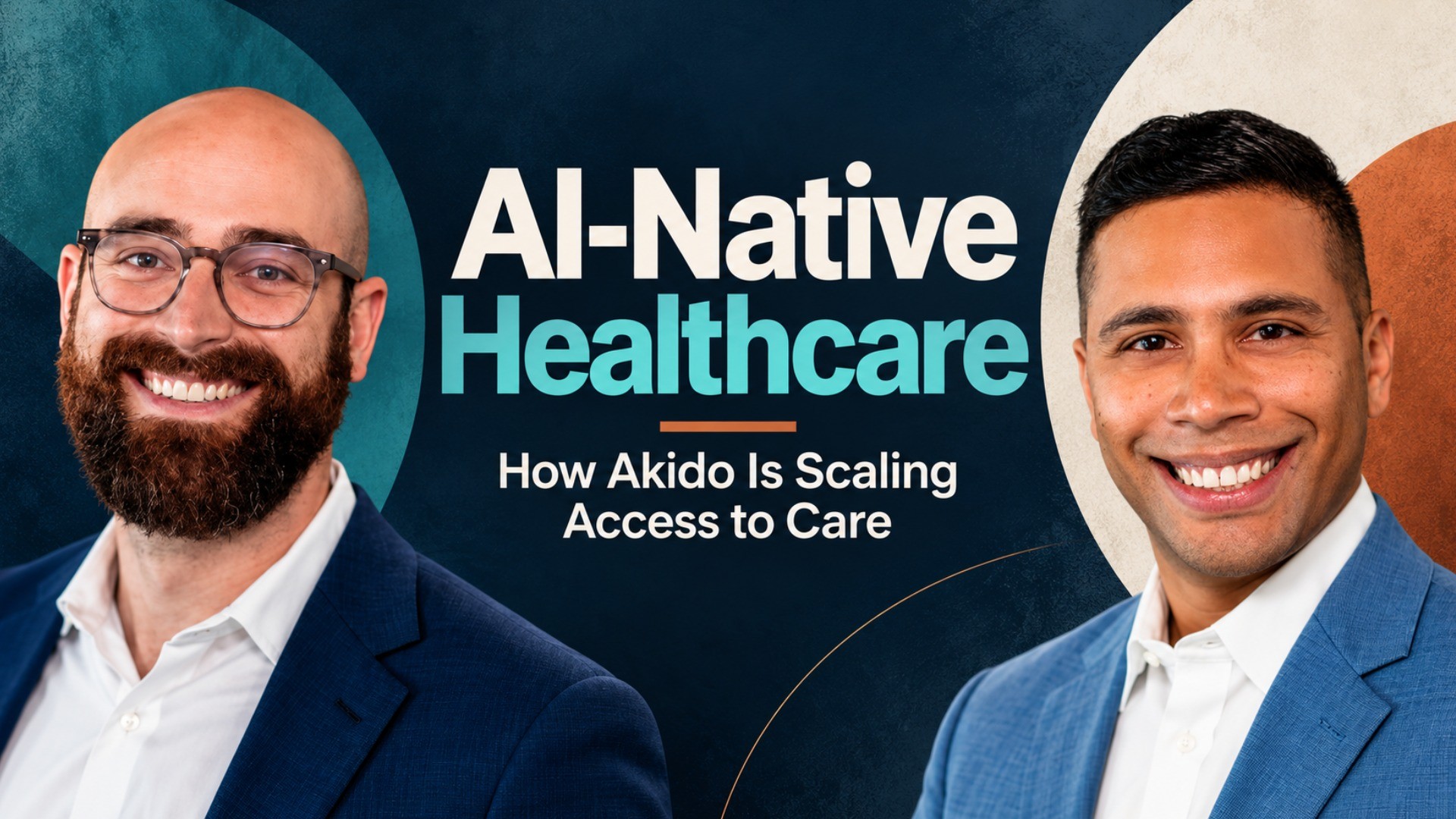
Akido is building what it calls the country's first AI-native health care system: clinics run on its clinical AI, ScopeAI, instead of AI added onto a traditional system. On HealthTech Remedy, oncologists Dr. Trevor Royce and Dr. Tim Showalter ask Akido's co-founders whether AI can expand physician capacity and reach underserved patients while keeping physicians in the loop.
Prashant Samant is co-founder and CEO of Akido, and Jared Goodner is its co-founder and chief technology officer. The two have built companies together for 20 years, starting with a nonprofit in 2007, and co-founded the USC D-Health Lab, the innovation center for Keck Medicine, from which Akido spun out around 2015. Goodner did his USC PhD in neural networks. Samant, the child of two county-hospital physicians, volunteered at Alameda County Medical Center in the 1990s and early 2000s. After using its data in COVID hot-spotting work with the CDC, the state of Delaware and LA County, Akido launched its own health care system in 2022.
The conversation covers how ScopeAI, which Akido calls an "omni-specialist," runs an AI-supported intake upstream of every visit so physicians can focus on the patients who need them; how Akido tests every model change against real encounters, including about 203,000 visits from its Pomona region in a single year; and how it designs care programs for people experiencing homelessness and for New York City rideshare drivers, with the Independent Drivers Guild and the Workers Benefit Fund. The co-founders also explain why faster adoption of value-based care would speed the spread of AI-native care.
Resources:
Akido: https://www.akidolabs.com/
ScopeAI, Akido's clinical AI: https://www.akidolabs.com/scope-ai
Akido Medical clinics and services: https://www.akidolabs.com/akido-medical
Akido leadership, including Prashant Samant and Jared Goodner: https://www.akidolabs.com/company
Connect with us:
Website: https://healthtechremedy.com/
Apple Podcasts: https://podcasts.apple.com/us/podcast/healthtech-remedy/id1807352650
Spotify: https://open.spotify.com/show/5RyEtTIOmRQaULJwCgbkoe
LinkedIn: https://www.linkedin.com/company/healthtech-remedy-podcast/
Newsletter: https://healthtechremedy.com/newsletter
A mouse in the kitchen
Dr. Trevor Royce: Hey, Tim, good morning.
Dr. Tim Showalter: Hey, Trevor.
Dr. Trevor Royce: It's always interesting around here in the Royce household. We are dealing with an infestation. There was a mouse in our kitchen, and I've never heard my wife scream like that, that loud and that long. I thought
Dr. Tim Showalter: Of what? Well, at least she know what her limits are.
Dr. Trevor Royce: Something had died. But we have a solution. There is a pest control guy in the neighborhood called the Batman, and he's gonna come save us.
Dr. Tim Showalter: But it sounds like he specializes in bats.
Dr. Trevor Royce: He does. We're gonna really test his capabilities here with this mouse.
Dr. Tim Showalter: It's something with this season, cuz I think we've heard them, or we haven't seen them sighted in the house, but we've heard them around, and we actually have a pest control group, so we're gonna have to, like, you know, yeah.
Dr. Trevor Royce: It's even worse when you hear him and you don't see him, cause you don't know. It could be a possum, could be a skunk.
Dr. Tim Showalter: It could be crawling over you at night. Yeah, exactly.
Dr. Trevor Royce: I could come in and get you. At least the emergency medicine spouse hasn't forced me to get my rabies shot yet, but I'm sure that conversation's happening.
Dr. Tim Showalter: You should get it now rather than, like, in the mouse bite, so.
Dr. Trevor Royce: All right, should we do it?
Dr. Tim Showalter: All right, let's do it.
What makes Akido an AI-native care provider
Dr. Trevor Royce: Welcome to HealthTech Remedy. This is the show where physician leaders in health technology break down the stories behind today's most innovative health companies and speak with the leaders shaping the future of care. I'm Trevor Royce, I'm an oncologist with a background in informatics and focused on bringing digital diagnostics to patients with cancer.
Dr. Tim Showalter: And I'm Tim Showalter, a radiation oncologist and former med device entrepreneur who's currently focused on scaling clinical AI to improve health care. And today, we are talking about Akido, a company that is working at the intersection of artificial intelligence, care delivery and health equity. And Akido is interesting. It describes itself as an AI-native health care provider. And that phrase is important, the AI native, because they're not simply building software and selling it into existing health care workflows. They are operating care directly through Akido Care, their medical network, and embedding AI into the clinical workflow itself through their platform.
Dr. Trevor Royce: Yeah, that's a pretty interesting framework and different from what we've typically seen. It's where tech-enabled first, and then traditional models kind of built on top of that, as opposed to the other way around, where you have your traditional system and you're seeing how your AI tools can fit into kind of your existing infrastructure. It's really kind of a bottoms-up approach, starting with the tech platform and building your care directly on top of that.
Dr. Tim Showalter: Yes. I think it's an interesting model. I think it's probably well suited to probe some core questions about AI in clinical care. Thinking, for example, can AI fundamentally expand clinical capacity and address physician workforce shortages? So think about in, you know, underserved communities who lack primary care and also timely access to specialists, for example. Is this a sort of model that can really help scale the available physicians in that discipline?
Dr. Trevor Royce: Yeah, it's their sort of scale and scope is impressive. Their network has, I think, over 100 brick-and-mortar clinics, and inclusive of primary care as well as specialties. So they're giving care, I think, for over a half a million patients with this platform.
Dr. Tim Showalter: Yes. And I think the other part that's interesting is that there is, if you look across the country at different specialties in different geographic regions, you will find a patchwork of underserved communities. So if you've got great orthopedic surgeons, you may not have a radiation center. I mean, it's just sort of kind of lumpy and uneven throughout the country. And I think what this gets at is that there are really just not enough physicians in some of these core areas. And I think that this fundamental approach where you're using AI on a platform that which they call, I think, ScopeAI is really interesting, because you can redesign the visit itself. So you can, rather than have that specialist in the room the entire time for the visit, you can have a medical assistant with AI help gather the history, structure the clinical reason, maybe even suggest next steps, and then ultimately have a licensed provider, be it a primary care provider or specialist, who reviews and approves that final plan.
Dr. Trevor Royce: Yeah, it'll be great when we have the interview to kind of hear exactly where the physician, for example, sits in this. You know, I'm assuming that, know, ultimately the physician is, of course, signing off and approving, you know, the actual care delivered and is sort of quarterbacking the system. But we'd love to hear directly from the Akido team. I mean, I think the core technology underlying it, as you mentioned, is their own proprietary systems, including an EHR and including their own proprietary data set where they're building these models. And then, as you mentioned, ScopeAI, which is the suite of AI models that are basically powering these workflows across all these different care settings, primary care, specialty care that we mentioned. And then I assume, again, sitting on top of that is the physician, kind of in control of that whole machine taking place underneath.
AI-enhanced vs. AI-native health care
Dr. Tim Showalter: Yes. I mean, just to draw a contrast to what we typically see, I, like, on this show and in our normal lives, I think you typically, we're thinking about the traditional health care organizations, so your large hospitals, your academic medical centers, being enhanced with AI. So deploying some sort of set of solutions that serve as what many people call a system of action that's adjacent to the health record. But importantly, that care is being delivered in the same system. Patients are coming into the building, they're checking in, they're seeing the provider in an exam room. And then ultimately, the documentation or a lot of the steps happens in the EHR. And that, I guess, you could call AI-enhanced at best, and different health systems are at various levels of deployment for that.
But I think what you just described well for Akido is that they're starting really from the ground up and have rebuilt the system.
Dr. Trevor Royce: Yeah, it's kind of gets to the difference between, say, AI-assisted care, which could be something as simple as using OpenEvidence, like, while you're in clinic to query clinical questions, versus truly AI-mediated care, where the AI is acting a bit more of a driver of the care. It sounds subtle, but I think it is an important difference that we'll have to hear a little bit more about.
Dr. Tim Showalter: Yeah, I mean, it's still clinicians in the loop, right? So there still is a medical assistant or, you know, some sort of community health worker who is interacting with the patient and who's supported by the AI platform. And then there's a licensed provider. But I think, you know, as both of us being physicians, we should point out, like, I think a lot of our colleagues might have a lot of questions about this: how many patients are being covered within a given unit of time. So I think it's important that there is a licensed provider who's got some time to think through these recommendations and pore over the information.
I think we've all got concerns as we use AI for various aspects of our professional lives about how the level of trust and reliance on AI. So will providers be tempted to just kind of blindly follow the recommendations? And if so, what are the cases in which that's okay and in which there's real risk involved? So I think the idea is to have the AI scaffolding and sort of the rails for care, but to make sure that clinicians are involved. But I think in action, it's gonna be interesting to see what the boundaries are there.
Dr. Trevor Royce: Yeah. Yes, absolutely. I mean, fundamentally, I'm all for any system that reaches more patients that need care that otherwise wouldn't get it, allows system, the health care system, which is inefficient and expensive, to become more efficient and less costly. Like this, these types of systems can undoubtedly help towards that. I think, as you described well, like, the entrenched interest pushback would be: what about the quality of the care? What about giving the right care? Safety obviously is going to come up with these types of models that are driving care this closely.
Dr. Tim Showalter: Yeah, as you're saying that, Trevor, I think it's a great point. The hairs on my neck prick up a little bit, because I'm so triggered by this comparison to perfect rather than comparison to what we have now. And I think too often when we talk about AI or really any technology in healthcare, the naysayers will say something like, "Well, it's not perfect because there's not a doctor in the room," or they'll have some sort of complaint that's a very traditional lens on this. But often the reality is that in this particular community, there's not access to good care in that space. Specialist care is a great example. So let's say endocrinology, you know, it's probably pretty challenging to get an appointment in many communities.
But you could also extend that analogy to primary care. I mean, we're all the time hearing stories that, you know, next available visit is four or five months from now. So I do think it's a great example where, if the comparison is that they don't have any care available in a timely fashion, or if it's not great care, it's possible with this platform to deliver excellent care, I would imagine, and make it available at scale. And so I think it's worth us, you know, really paying attention to this trend overall.
Dr. Trevor Royce: Yeah, I think it's really well said. It reminds me a lot of the discussions that happened around telehealth and virtual care, particularly during the pandemic, in terms of, like, you know, the bear case where, oh, what about the, you know, the quality that patients are getting? Are physicians going to be seeing more patients than they can safely see or should see? Are they going to be, know, watching the World Cup while they've got their feet up on their desk and the machines are, you know, the ones actually giving the care, that sort of thing? So yeah, absolutely.
AI, health equity and underserved patients
Dr. Tim Showalter: All right. Well, I'm glad to hear we're on the same page for that. I think the other thing that I'm interested to learn more about with Akido is that they're testing this model in some pretty compelling ways. So a lot of times we think about starting with either commercially insured, sort of digitally fluent patient populations, or folks who want to pay cash directly for virtual care. But I've read that Akido is doing a lot of its interesting work with people who are not able to access traditional health care. So they may be experiencing homelessness, they may have some challenges with their work roles. I even read something about rideshare drivers accessing Akido.
And so I think it's a real great example of the extremes of populations that can be served by a model like this. And it's also, I think, developing some compelling case studies for Akido as well.
Dr. Trevor Royce: Yeah. And I'll just quickly call out, they've got a pretty interesting history. You know, they're one of the big health tech companies that spun out of the famous incubator Y Combinator. So, you know, they come from a sort of very successful tech ecosystem, now, you know, applied to health care. And I think what they're trying to do makes a lot of sense, and I hope they succeed.
Dr. Tim Showalter: Well, as we move to the interview, I guess, maybe each of us can reflect on some exciting component of this. What I will say is that I'm most interested in how Akido directly addresses this concern about equity in AI-enabled care. A lot of us who follow this area closely have heard concerns about AI expanding inequity. And the example would be, patients of means who are well-insured and can pay cash on top of that are gonna receive, you know, the best care available, plus they'll have the support of their brick-and-mortar health system nearby, and they're just gonna access all the services they want and a ton of services. But I think this is a great example, when you think through the impact that the Akido model can have with underserved patients, to make sure that AI is delivering a lower-cost, you know, more streamlined version of care. And so I like that they're heading straight to that.
Dr. Trevor Royce: Yeah, one thing that I'd love to hear from the interview side is what the Akido experience is like from the provider perspective. Obviously, I'm biased as a physician, but would be really interesting to hear how they balance that trade-off between the control on the physician side and scalability and being able to reach patients that otherwise want to get care, how that fits into these health care models, like a multi-specialty care delivery system, where you can still balance that cost, quality and access to care.
Dr. Tim Showalter: Yeah, we should ask them, like, what the revenue model is too. I'm interested to hear how they're actually getting paid as well. So with that, why don't we move on and bring in co-founder and CEO of Akido, Prashant Samant.
Dr. Trevor Royce: Looking forward to it.
Akido's founders and the USC D-Health Lab
Dr. Tim Showalter: Welcome back to HealthTech Remedy. We are excited to have two guests today for the interview, which is quite a treat. We have Prashant Samant, who is co-founder and CEO, and chief technical officer Jared Goodner, both from Akido. So, welcome to the show.
Jared Goodner: Thanks, Tim. Thanks, Trevor.
Dr. Tim Showalter: Really excited to hop in and hear more about the origin story of Akido. Maybe before we hop in about the company, though, I'd love to hear, I think, maybe first from Prashant and then from Jared about your backgrounds prior to Akido. What would tell give it catches up a little bit on what your professional experiences were beforehand.
Prashant Samant: Sure. So gosh, Jared and I have known each other for 20 years, and we've been building companies at the intersection of technology and social impact pretty much since we graduated college. So the first thing we built was a nonprofit organization in '07 that helped local charities raise money during a really challenging time economically, the financial crisis then, and, know, been focused on sort of how do we create technological systems that address systemic inequities in different aspects of life. And health care is just one of those areas where we see an opportunity for tremendous good, not just for people's health but also for things around systemic inequities that ties to the social determinants of health. So to explore that subject, we started the University of Southern California D-Health Lab, which was the innovation center for Keck Medicine.
If you're all familiar, Keck Medicine is kind of controls the east side of healthcare in the Los Angeles area. Jared was doing his PhD in neural networks then, and we spun Akido out of that lab in, what, 2015? Something like that.
Dr. Trevor Royce: That's amazing. That's like super OG neural networks, you know. That's all the rage now, but you've been working in this space for a long time.
Jared Goodner: Right. That's a good way to describe it, as the old world. Yeah. So, my PhD was centered around modeling spinal cords with more biologically oriented neural networks, spiking neural networks, they're called. And so, those look different from the neural networks that we design and work with today, but all part of that evolution. So, I think Prashant described my background already, essentially. Prashant and I had founded an organization in the nonprofit world before I went back to do a PhD in at USC, and from there, we saw this tremendous opportunity to leverage this kind of burgeoning data set, which was being produced by EMRs back in, you know, 2010, 2011, and that was, in large part, the inspiration for the D-Health Lab.
We felt pretty strongly that, you know, some technological development on the heels of this data coming online, and it being accessible in many times for the first time in history, could be utilized to address what we see as sort of the root cause issue behind a lot of the inequity we see in health care, is that physician's time, provider time, is the scarcest thing of all. And so everything we've built from the University of Southern California D-Health Lab has come out of that orientation.
Dr. Trevor Royce: And Prashant, my understanding is that, you know, this kind of origin story, for obvious reasons, but maybe some not so obvious to our readers, is that it's personal for you, and that you saw maybe in your own household growing up how you might be able to solve some of these issues.
Prashant Samant: Yeah, I mean, my parents are both physicians. They both work in county hospitals. You know, my dad's in the ER doc, my mom's a gynecologist, OB-GYN. My mom, I'll just say it, he knew he couldn't become a doctor, and so he did what he could. Certainly, yes, certainly, it was like there's no chance of him doing that. But I got to spend a lot of time, or asked to spend a lot of time, particularly during the '90s and, you know, early 2000s, volunteering at Alameda County Medical Center, which was a fascinating and, know, dark and, know, really courageous place to practice medicine in a lot of, still the height of the AIDS epidemic, and a lot of inequity around access to care. And so just kind of seeing front hand the incredible amount of work and time and energy that providers and other health care workers are putting in to try and do good, and just the uphill battle around that. And so just felt that there has to be a better way.
From data lab to COVID hot-spotting to clinics
Dr. Tim Showalter: Fantastic. And looking back, it seems like Akido's been started in 2015. And I know there's, initially the focus was generally on some data and technology to focus on this general area. I'm curious if you could walk us through the generations of the company and, like, what the focus has been and how that's evolved over time? Like, what did it look like in the first few years? And then how did you get to where it is now?
Dr. Trevor Royce: And just to quickly pile on that, like, fundamentally, like, what core problem are you guys out to solve?
Prashant Samant: Sure. So just quickly on what Akido looks like today, you can think about it as a combination of two organizations. Just for simplistic framing, it's a full-stack R&D organization that houses a very large and growing clinical case study data set, and then a full-stack multi-specialty health care system. Everything from scheduling to revenue cycle management happens in-house, and we have, you know, both primary care as well as specialty care, so cardiology, endocrinology, rheumatology, pulmonology. And so it's an intertwining of those two organizations that enables what we do, but we didn't start out as that. We started off with the premise that to build anything valuable and useful using data in health care, you need to bring together a lot of usable data in health care. The goal was to create models that could either predict worsening health conditions or, you know, and back then a little bit more of a reach, of automate aspects of what providers do, so we can scale them more effectively. But the challenge that you just really don't have access to enough good, clean, organized data, and this was 2015.
We saw that firsthand with Cerner being implemented at USC. A lot of amazing things are possible, but it was really clear that the more data we can organize and bring together, the better models that we could build. So for the first five years of the company's history, we were basically assembling different data sets together, just using technology that managed governance, compliance and integration to bring together disparate data sets, so we can create these clinical case studies that we could ultimately use for better predictive modeling, again, either to predict worsening health conditions or automate different aspects of the clinical investigation process. And kind of the do-or-die moment was during COVID, where it just became really critical that the better we can do hot-spotting in different parts of the country and different populations. We had a limited supply of test kits, a limited supply of vaccinations, and it was really a call to action for us and other organizations that were in this intersection of program development and predictive model creation.
So, you know, went to work with different organizations, ranging from the CDC to the state of Delaware to LA County, to do different kinds of hot-spotting of where COVID was gonna pop up, leveraging our data set as well as other program partners, to more accurately and in a nuanced way predict where COVID was coming next. So that was sort of like, you know, a trial by fire: is our thesis working out? And it was, felt really proud about that. And then launched our healthcare system in 2022. You know, to go back to your question, Trevor, of the problem we're focused on, we started the lab at USC, like, it really hasn't changed. We have a significant under supply of care delivery resources: providers, physicians, what have you.
And, you know, most optimistically, we have, what, like 20% of the providers we need to take care of the population and the level of illness we have in this country today. So it's not a problem that training can just solve, and it's not a problem that we could even solve with immigration, because there's an even greater shortage of doctors or providers outside of this country. So we felt that with new technology, leveraging data, if we could predict worsening health conditions and automate parts of what doctors do to scale their capacity, you could tackle that problem very, very, very directly. Either by reducing the burden of care needs or by increasing the capacity on a per-provider basis.
So fast forward to 2022, once we felt confident in our technological approach, once we felt confident that we could make better models with this data, we launched our own healthcare system, so that we can take the best advantage of this technology to reimagine how care delivery operates, how care delivery works, how we bring models that predict worse health conditions into an outpatient operation that takes full advantage of that early prediction.
What practicing medicine with ScopeAI looks like
Dr. Trevor Royce: Yeah. This makes perfect sense to me. And I think the phrase that I saw that really kind of encapsulates what you guys are trying to do, which I'm cheating because I pulled it off your website when I was reading about you guys some time ago, was this idea of health care superabundance, and, like, using technology to unlock this true, like, bottleneck that we have on the human element, where you only have so many providers that can see so many patients.
Prashant Samant: Yes. I mean, I would add a couple of nuances to it, I guess. You know, look, at this point, Akido is squarely focused on building the, you know, the country's first AI-native health care system. You know, we have over a million patients in our catchment, you know, we keep physicians in the loop. And I think, you know, as physicians yourselves, as we think about, you know, how do we create this superabundance, I think a lot of people have a fear that AI in medicine, it means losing that provider relationship. We built towards the opposite: AI that extends the physician's reach as opposed to replacing their judgment. We feel like, as that continues to evolve, I think that the nature of what providers might do and be responsible for might evolve as well, but ultimately it's about scaling their judgment, not replacing it.
Dr. Tim Showalter: I'd love to hear a little bit more about that, because I think so many of us who practice medicine practice in traditional health systems. We're on the, you know, the large EMRs, and patients come and see us in person. And there's a lot of efforts to overlay AI on top of that and to try to get leverage the physician bandwidth that way. But you're taking a fundamentally different approach. And just to expand a little bit on that, I wonder if you can share with us more thoughts on how, maybe from, put yourself in the perspective of a physician, how different the experience would is in a health system like you're building that's more AI-native versus the current experience of folks who are in a traditional system and layering on some AI tools.
Prashant Samant: Sure. I mean, Jared, do you want to go through kind of what a ScopeAI-enabled process looks like?
Jared Goodner: Sure. So, you know, Prashant talked about how we built up the capability to, you know, from a technology standpoint, introduce our own health system. The reason why, or one of the reasons why we felt that was so important was because it allowed us to rebuild much of the kind of non-technical stack alongside rebuilding the technical stack to support much more automation in a health care setting. So, Tim, know, kind of the way you describe things is what we have expected to happen throughout most of the industry, and the reason why we decided to essentially build our own. What we've done, essentially, is established opportunities to introduce artificial intelligence or some aspect of prediction throughout almost every step of a patient's journey.
And the end result of that for the patient is a lot more access to care and a lot more opportunity for various types of treatment. And for our physicians, it looks like, actually, it looks very similar to how it looked before. However, the focus is much more so on patients' needs that really do require them, either in person or remotely, in that moment. And so often that leans towards more patients with more complexity, patients with higher acuity. And so oftentimes what we hear from doctors is that these are the kinds of things that I kind of always imagined taken off my plate anyway. Right. So ScopeAI itself, that's what we call our suite of neural networks and predictive technologies, runs a full clinical workflow.
So from investigation to diagnostic support to orchestration of every subsequent event, essentially decides which models to call and when, whether that's predictive for risk, generative models for interviewing patients without a physician in the room, documenting, reinforcement learning throughout the process. So from the standpoint of a doctor, to get back to that, we place an AI-driven investigation process kind of upstream of any visit in our network. And what that means is that we have medical assistant, or somebody trained in that sort of relationship building, to do that first communication with a patient. That is kind of like a very thorough intake plus scenario, where we're looking to identify many different diagnoses associated with what that patient came in for.
So that could be an issue associated with cardiology, or it could be an issue associated with kidney, or with an aspect of ortho. Scope is what we call an omni-specialist. And so we're not necessarily focused expressly on what they came in to see a specialist for in that moment. What that allows us to do is to generate many, many different diagnoses or opportunities for treatment. And we pass that on to different parts of our health care system with different AI models. And our physicians, our precious resource here, really focus on the opportunities that require their input, and that's together is what enables us to really amplify the capacity of our system.
Prashant Samant: I think amplify the capacity system and also deeply personalize the experience of care to the patient segment. Know, we treat everybody from people experiencing homelessness to, you know, chronically ill seniors with multiple comorbidities. And the reality is that depending on the patient context, within people experiencing homelessness, you have, you know, male versus female patients. Female patients that might be coming from a circumstance where they've been battered, and their level of comfort with a certain kind of interaction is gonna be different than a male. Both these patients are probably gonna be very difficult to get to come into a clinical facility, and so you're gonna wanna send somebody out in the field. And right now that is not only cost-prohibitive, but let's say you do get, know, volunteer doctors to go out into the field and do a particular kind of investigation, you're not gonna be able to get a comprehensive understanding of what's happening with that patient. But having that investigation process supported by Scope, which, as Jared mentioned, is a true omni-specialist, coupled with, you know, let's say a caseworker or somebody with lived experience going out to interact with this patient, you can cover as many conversational areas of medicine as is allowable in a far extended amount of time, because you're not bound by the physician's time.
You're not bound by the same amount economic limitations as before. And so, you know, for, again, for a person experiencing homelessness, we might have somebody who goes out in the field multiple times a month, because that patient does need ongoing evaluation, and the more touch points we have, the more likely we can pull that patient into a medication-assisted treatment program for an addiction, or we can more likely get them to engage with social workers to help them get them off the streets. But the whole program might be different for a senior who is generally at home with a couple of morbidities, and their experience of the world is going to be a bit different.
What they're going to need from a care model standpoint is going to be different, and that personalization that historically is reserved for extremely, you know, people with a lot of means, we can create that same kind of experience for everybody, and, you know, within a world that is paid for by insurance, within a world that is within today's regulatory environment. It's a long answer to a short question, Tim.
Dr. Trevor Royce: Amazing.
Dr. Tim Showalter: That was a great answer. Appreciate it.
How large language models changed Akido's AI
Dr. Trevor Royce: Yeah, it's really good perspective. I mean, as you mentioned, you guys have been thinking about and in this space for a long time, well before large language models and frontier labs were in vogue. And maybe Tim's a little older than you guys, been at it a little longer, but you guys have been at it for a long time. But I'm, I would, but
Dr. Tim Showalter: You could have softened that. You could have said that in a kinder way.
Dr. Trevor Royce: I'm curious from your perspective, and maybe this is a good one for you, Jared, particularly, but has that frontier labs moment changed how you guys are thinking about this? How has it impacted tech stack and some of the problems you're able to take on and solve?
Jared Goodner: Sure. Yeah, absolutely. You know, I think that, like Prashant said, our vision has always been set on both prediction of progression of illness as well as that clinical automation side. And, you know, language models and transformer technology in 2018, 2019 is really what started to kick off that clinical automation piece, truly, because so much of that part of medicine, at least where we focus, in the world of specialty medicine and primary care, is so heavily driven by conversation. And so, no question, language models and the progression and incredible progression of LLM technology has been a huge boon for what we do. We have also seen a tremendous amount of synergy with, know, the first six years of the company, focused around building up that data set. We spent a lot of time and a lot of resources not only, like, amassing a large data set, but also cleaning it and enriching it.
And so the result there was that we could very easily convert that corpus into a corpus that was very friendly with language models. So, you know, let's say 10 years ago, our focus was on discrete data. Now our focus is on creating case studies, essentially, to train language models. And so that was highly applicable in that world and is the reason why we saw so much of our early success. Another piece that is really, really important from a technology standpoint, that we see we have a huge advantage in, is the reinforcement learning piece. So having our own physicians in our own network providing feedback to our models on a continuous basis as they perform their job with the patient.
It's really important for us to identify edge cases in medicine that the models may not be predicting effectively. And so we see that also as a really important advantage that we have as a system from a language model standpoint too. You know, I think that there's been a lot of talk lately around, know, fully automating physicians, around whether, you know, models can replace doctor decision-making. Yes. Or I guess it is, like, we're pragmatists. We're not trying to pick a side in that debate. The goal really, I think the question is the wrong question. The question is: how do we improve patient outcomes? And what is the best way of doing that, and the most cost-effective way of doing that? Not just because we want to make a buck, but mostly because we want to be able to reach the scale that we need to take care of people today. And so physician in the loop has its role.
Full automation has its role. But the goal is how do we get this into people's hands now so they can be better.
Benchmarking AI quality across a whole network
Dr. Tim Showalter: Yeah, it's great to hear the story, and it makes a lot of sense for me how the initial experience in terms of building a really strong database, like a clean data set, and making sure that you've got the right data to train, validate and up with a really powerful tool makes a lot of sense. And then I think the concept of the physician in the loop, and in keeping humans involved and in serving human patients, is all really important. I'm curious how you focus on an ongoing basis on quality concerns and feedback from physicians. You mentioned having a feedback loop with clinicians that are involved there. I'm curious if you could say more, because it seems like that's a real opportunity where your platform can continue to improve by incorporating that feedback.
Jared Goodner: Oh, it certainly is. Quality and safety are extremely important, also, you know, fairly tricky in our domain. Know, there, I think the industry for the past few years has really struggled to come up with meaningful benchmarks that apply to a wide variety of the different models that are being built. And so the approach that we take, we think, is actually fairly novel, where we call it total addressable medical situation space, long-term TAMs. And what we do here is we sample our entire network, essentially, for the encounters that have happened throughout for the past two to three years, and use those as testing grounds for every model improvement that we make. And so what it allows us to do is to identify in a very granular way where the models are performing and where they're not performing, and be able to apply engineering resources to the places where they're not performing.
But also to be able to say very clearly that this aspect of quality is in a place where it needs to be and this aspect is not, to allow us to, you know, expand from one specialty to another, or to a different level of acuity within that specialty, for example, the, you know. So I guess, just to apply some numbers to that, if that's helpful. So in our Pomona region last year, about 200,000, 203,000 visits came through. And so that's the level of testing that we typically do across our models, is take those 203 visits, every single visit in Pomona last year, run it through our models to see what the output looks like. And so we get a really, really clear picture of how those models perform in a setting that is very similar to what our models will see next year, if that makes sense.
Yeah, I think that's a really big differentiator of having our own full-stack health care system. Not that I think, I know that's, you know, that's the gold. And having 26 different specialties, having every single interaction quantified from the first touch point on a scheduling standpoint, all the way through clinical investigation, all the way through the differential diagnosis process, all the way to order generation and then ongoing monitoring of that patient, which, as you both know, I'm sure, is very challenging to do in any health care system. But in terms of giving us a target across every component of this more autonomous health care system that we're developing, we can be really granular on whether or not it's the right or the wrong next step.
And that's just based off of a huge sample size of historical data across those clinical operations. I don't know of any other organization that has that vast of a targeting mechanism. I think that in certain projects, you know, research projects from Google or Microsoft, they're doing, like, really small amount of case studies that are sometimes handmade by providers, or, you know, something that they can get that is useful for a narrative or a story, but not necessarily for production-grade or commercial-grade implementation, and generally narrow in terms of what it's covering, maybe the differential diagnosis process or maybe a full case study that they're trying to get a diagnosis out of. This is really important, because in actually turning artificial intelligence into clinical investigation and into treatment, you need to be able to see the entirety of what a health system does, not just, like, a little snippet of something to see if your model is doing well, you know.
You have to know that you're interacting with the patient properly before a clinical investigation, during a clinical investigation, after a clinical investigation, bring, are they getting treated in an appropriate time frame? All of these questions matter in terms of being able to create something that truly scales patient outcomes, I guess, or improves patient outcomes at scale.
Health care for New York rideshare drivers
Dr. Trevor Royce: Totally. And I think, you know, one kind of use case I wanted to ask you guys about while we still have some time, just because I think it's an amazing visual of kind of your capabilities, is the New York rideshare program. You know, it's kind of a topic that's been in the news a bit, about, know, Amazon and how they treat their workers and their drivers and so forth. And I think, like, it wraps into this kind of bigger question of how, like, do we get health care and benefits to people that are doing hard work, but in independent ways. And I would love to kind of hear an update on the rideshare. Maybe tell the audience a little bit about kind of the background about it and what the latest is on that.
Jared Goodner: Sure. I guess zooming out on the first second, every single time we think about how do we bring this to a patient, we now have the luxury of being able to make it very patient-centered. And so, you know, whether that is a person experiencing homelessness, whether that is vulnerable women, whether that is rideshare workers in New York City, which are different than rideshare workers in different cities as well. And each one of these patient segments oftentimes has, know, a community of workers, whether they're clinical or case workers, that understand that patient population very well, what they're going through, and we can collaborate with that organization, or with these organizations, to arrive at what the most optimal clinical or comprehensive whole-person care program for that patient segment.
With the rideshare workers in New York City, the real heroes there are the Independent Drivers Guild and the Workers Benefit Fund. They are responsible for advocating for this workforce, for supporting them across a wide variety of different means. And they have an understanding of what this patient population needs and what the design constraints are for getting it to them. And so, know, we started a journey with those organizations to figure out: where do they currently go for care? Where do the patients currently go for care? How often are they getting it? What are their typical ailments? And working back or from that, arrived at a care program for initially the high-acuity subsegment of that population, and then over time we'll collaborate with them to figure out how to scale that to the entirety of that population segment. And so, you know, we're going from phase one to phase two right now, and continuing to kind of design components that programs that it works within the construct, or the confines, of that patient segment.
The obvious thing is that if this patient stops driving, they don't make money. They increase their risk of being unhoused every time they're taking a break from driving to do something that might be self-care and orientation. So solving for that isn't an obvious answer, and it's not entirely just a clinical answer. It's also kind of an accessibility care answer, and helping that patient make time for this when every part of their fiber being says, "I can't make time for myself, I have to go drive, otherwise my family's not gonna feed itself," so.
Value-based care and scaling AI-native health care
Dr. Tim Showalter: Thanks for that. It's a great example of the sort of problems that you're solving, as well as, I think, some really important first-principles thinking for health care. I know we're moving towards the end of our time, and I did want to close with a little, maybe a broad question to get your thoughts on. You're clearly making a ton of progress and a ton of impact, and, of course, I'm sure you always want to move faster and have a broader impact on health care. If you could change one thing about the U.S. health care system at this point to make this kind of a care model scale faster, what would it be?
Jared Goodner: Oof. Gosh. We spend so much of our time assuming that's not gonna change, so I'm not even sure where to begin there. I mean, I think that, look, we've designed our care models, and, you know, at this scale, Akido is a part of the American health care tapestry. Akido Medical, you know, like 40% of primary care in Rhode Island, for instance, happens through Akido Medical. We're not going anywhere. And I think, you know, with the size and scale of the health system, the kinds of patients that we treat, and just our sheer penetration in these markets, we see everybody across every payment model, and we've designed for that, because we assume that no matter how high our hopes are for a true value-based care ecosystem, we're still multiple segments of a journey away from that. That said, I think that in a value-based care, loaded term, lots of sub-definitions of it in there, I think that if we can more rapidly accelerate the adoption of that health care economic model, the faster we'll see propagation of more autonomous health. Because at the end of the day, what we're doing is we're being able to see patients more frequently, to evaluate them more frequently, in a more comprehensive way, at a lower cost basis. And if we can do that, that dovetails really nicely into being able to save the health system money. And hopefully, the more reward is out there for that kind of work, the faster you'll see these kinds of models being adopted by people that are in the legacy healthcare system, or people that are trying to disrupt with new healthcare models.
Dr. Trevor Royce: That is a fantastic vision, and I think probably a good place for us to wrap on. But I will say, with that, we should probably plan on having you guys back in about two years, because I'm very excited to see where you guys go and what the future looks like. So it's been a wonderful conversation. Look forward to having you guys back again soon.
Jared Goodner: Thanks, Trevor. Thanks, Tim. Good...
Dr. Tim Showalter: Yeah. Thanks so much, guys. Appreciate it.
Jared Goodner: ...to see you.
HealthTech Remedy is produced by Podcast Studio X and is powered by BuzzyPod.